
The Complete Birthday Party Planning Checklist: A Stress-Free 8-Week Timeline
Birthday party planning checklist systems should do more than remind you to buy balloons and order a cake. A genuinely useful plan connects the guest list, budget, venue, menu, activities, staffing and schedule so every decision supports the same celebration—and so the host is not solving preventable problems while guests are arriving.
This guide presents a professional planning system that scales from a small home birthday to a larger venue event. It includes an eight-week timeline, budget framework, guest-flow plan, food and beverage controls, vendor checkpoints, a run of show, contingency planning and a detailed day-of checklist.
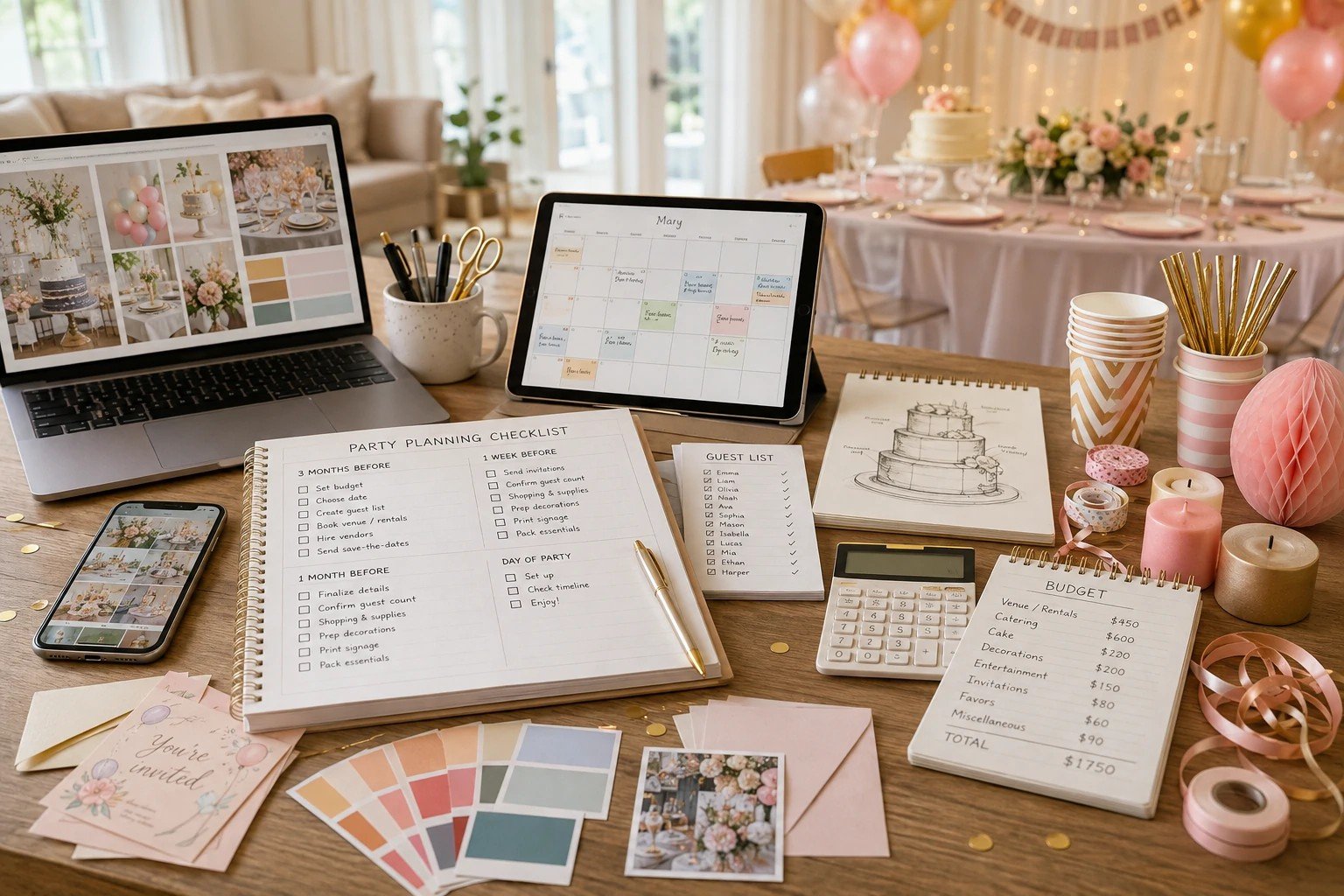
Decide the experience before buying the objects. First define who the party is for, how guests should feel, how long the event should last and what the budget must protect. Only then choose the venue, theme, food, decorations and activities.
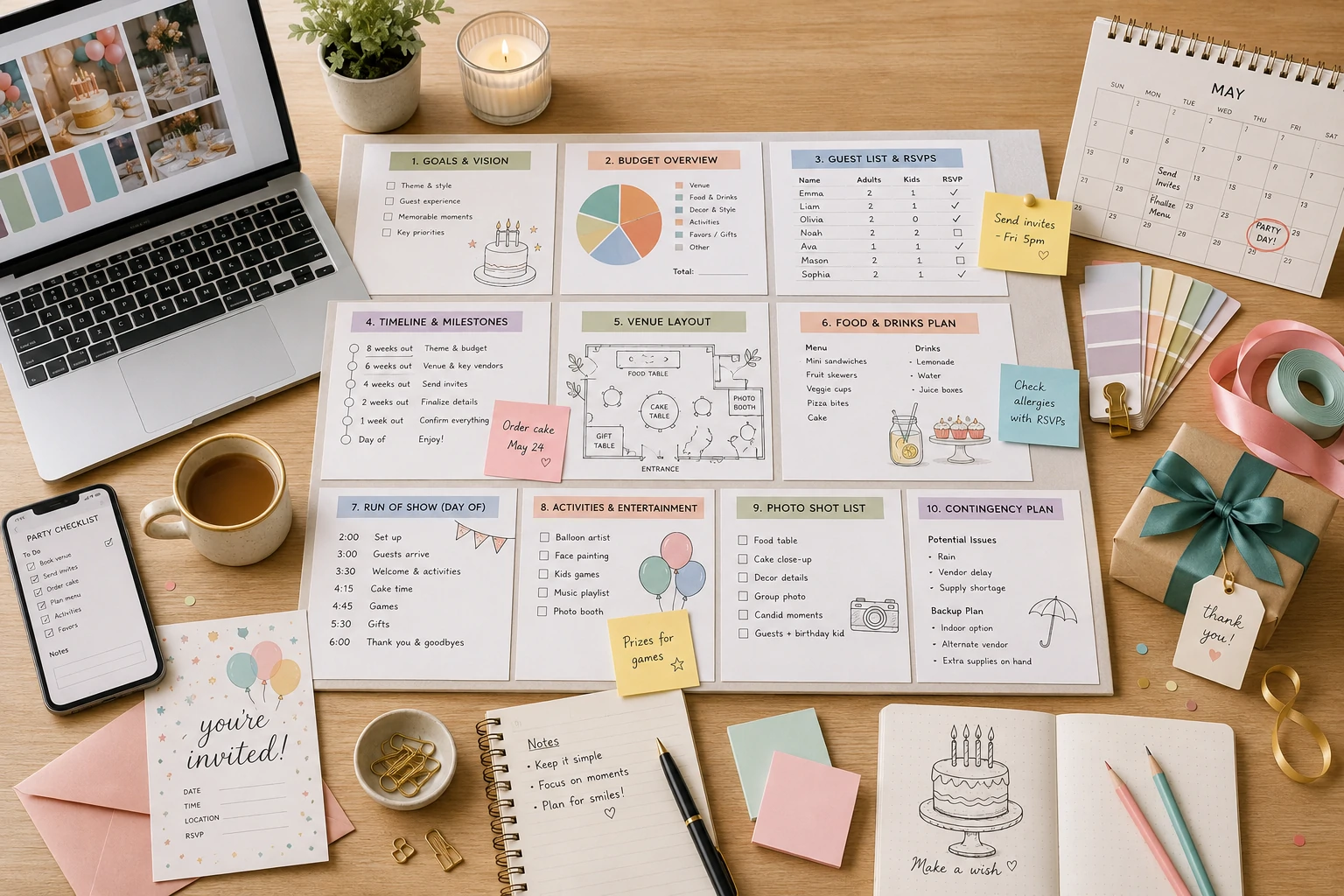
Start the Birthday Party Planning Checklist With an Event Brief
Before searching for themes or vendors, write a one-page event brief. This is the decision filter for the entire party. When two options compete, choose the one that supports the brief more clearly.
- Guest of honor: age, personality, interests and comfort level.
- Primary objective: family connection, high-energy entertainment, elegant dinner, children’s play, milestone celebration or another clear outcome.
- Guest profile: expected count, ages, relationships, dietary needs and mobility considerations.
- Event format: open house, seated meal, activity party, backyard celebration, surprise party or venue package.
- Duration: planned start, finish and any hard venue deadlines.
- Budget ceiling: the maximum total—not the hoped-for total.
- Three priorities: areas that deserve the strongest spending and attention.
- Three non-priorities: details you are intentionally keeping simple.
- Success measure: what must happen for the party to feel successful?
Build a Birthday Party Budget That Includes Hidden Costs
A useful budget separates fixed costs from guest-dependent costs. This makes it easier to understand what happens when the guest count changes.
Fixed costs may include the venue, entertainment, photography, backdrop, equipment rental and delivery fees. Variable costs usually include food, drinks, tableware, favors and admission-based activities.
A Practical Starting Allocation
The percentages below are a planning model, not a universal rule. Adjust them according to your priorities and local prices.
| Category | Starting range | What belongs here | Common mistake |
|---|---|---|---|
| Venue and equipment | 20–30% | Room, tables, chairs, linens, permits and rentals | Ignoring setup, cleaning, overtime and delivery charges |
| Food and drinks | 25–35% | Meals, snacks, cake, beverages, ice and serving supplies | Budgeting for ingredients but not service items |
| Entertainment and activities | 10–20% | Performers, games, craft materials, prizes and fees | Booking entertainment that does not fit the guest ages |
| Decorations and stationery | 10–15% | Invitations, signs, balloons, florals, backdrop and tables | Decorating every surface instead of one focal zone |
| Photography and keepsakes | 5–10% | Photographer, prints, booth, frames and memory items | Leaving photographs to chance |
| Contingency | 8–12% | Weather changes, replacements, overtime and late fees | Spending the reserve before the event |
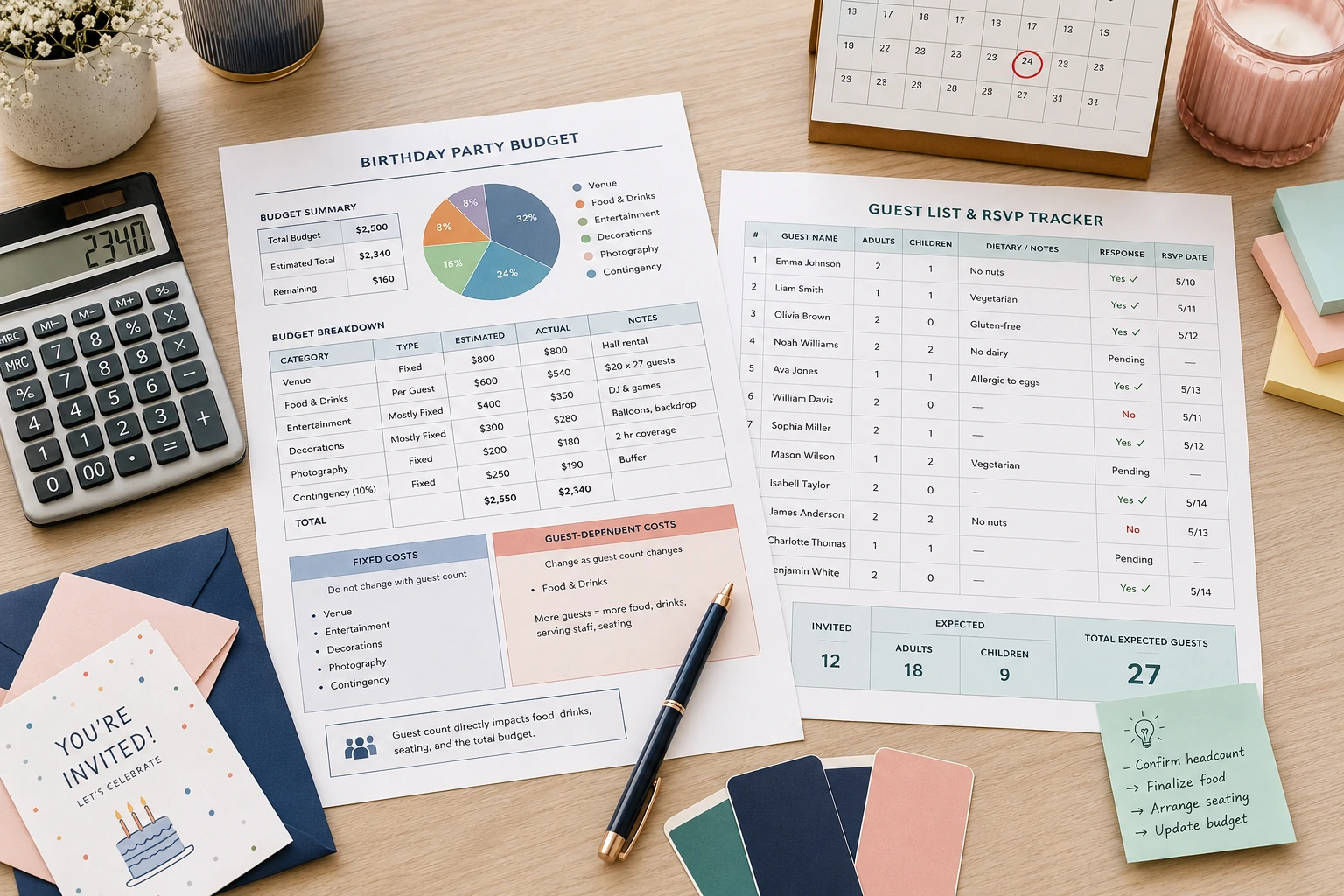
- Set the maximum total budget.
- Reserve contingency money separately.
- Record deposits and final-payment dates.
- Check cancellation and rescheduling terms.
- Include tax, tips, delivery and service fees.
- Track refundable deposits separately.
- Calculate the variable cost per additional guest.
- Define who can approve an unplanned expense.
Design the Guest Experience Before Finalizing the Guest List
The guest list is not just a list of names. It determines the venue capacity, seating, menu, activities, staffing level and party pace.
Map the Guest Journey
| Guest stage | Question to solve | Planning response |
|---|---|---|
| Before arrival | Do guests know the address, parking, dress code and start time? | Send one clear information message 48–72 hours before the party. |
| Arrival | Where do coats, gifts and strollers go? | Create a visible drop-off zone that does not block the entrance. |
| First 15 minutes | What should early guests do? | Offer drinks, a simple activity or a clear social area. |
| Food service | Can guests move through the buffet without crossing the activity zone? | Separate serving, eating and play areas. |
| Main moment | Can everyone see the cake, speech or activity? | Choose the focal position before placing tables. |
| Departure | How are favors, leftovers and transport handled? | Prepare an exit table and assign one person to manage it. |
Use RSVP Information as Operational Data
Your RSVP form or message should collect more than “yes” or “no.” Ask for the number attending, children’s ages when relevant, dietary restrictions, accessibility needs and a reliable contact number.
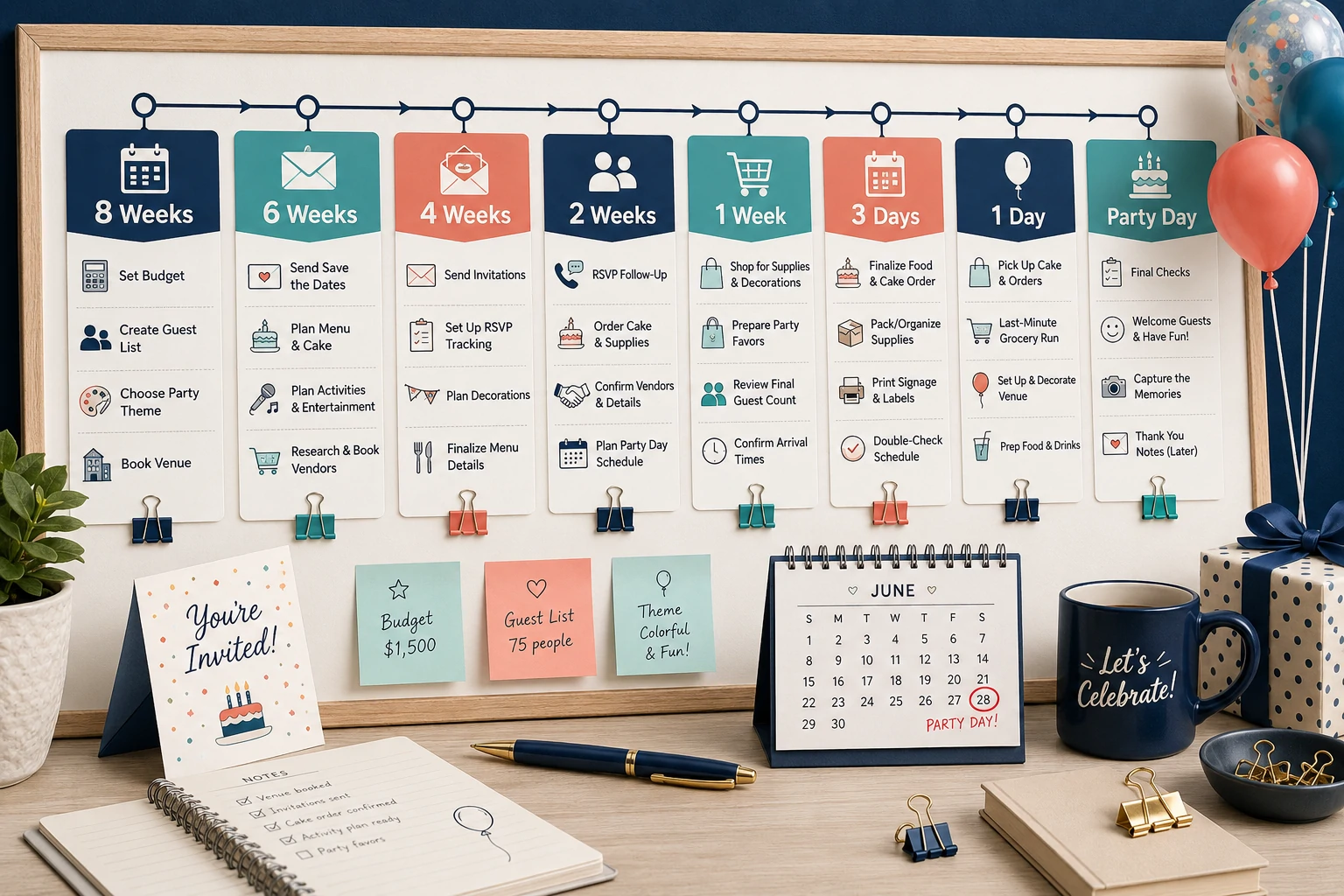
The Complete 8-Week Birthday Party Planning Timeline
Eight weeks gives enough time for most home, restaurant and small-venue celebrations. A larger milestone event may need three to six months, while a simple home party can be compressed into two to four weeks.
WKS
Eight Weeks Before: Lock the Foundations
- Write the one-page event brief.
- Set the maximum budget and contingency reserve.
- Create the preliminary guest list.
- Select the date, backup date and preferred time.
- Compare home, restaurant and venue options.
- Book the venue or confirm the home layout.
- Choose the overall format and three priorities.
- Start a shared planning document with owners and deadlines.
WKS
Six Weeks Before: Book Limited-Availability Items
- Book entertainment, catering, photography or rentals.
- Confirm contracts, deposits, cancellation terms and arrival windows.
- Select the theme, color palette and dress guidance.
- Send invitations or save-the-date messages.
- Plan accessibility, parking and weather alternatives.
- Identify permits, venue rules or insurance requirements.
WKS
Four Weeks Before: Design the Guest Experience
- Draft the menu and beverage plan.
- Choose activities appropriate for the guest ages.
- Create a floor plan for arrival, food, seating, activities, cake and photographs.
- Order decorations, personalized items and nonperishable supplies.
- Prepare the first version of the run of show.
- Assign a host, food lead, activity lead and photo helper.
WKS
Two Weeks Before: Convert Plans Into Quantities
- Review RSVPs and follow up once with nonresponders.
- Confirm dietary needs and accessibility requests.
- Calculate food, drinks, seating, tableware and favor quantities.
- Test DIY decorations, games or equipment.
- Confirm vendor contact names and final-payment dates.
- Build the shopping list by store and purchase deadline.
WK
One Week Before: Freeze the Plan
- Set the final guest count and communicate it to vendors.
- Finalize the run of show and delegation list.
- Check the weather and activate backup decision deadlines.
- Buy shelf-stable food, drinks, batteries, candles and cleaning supplies.
- Prepare signs, playlists, trivia, games and printed materials.
- Create labeled setup boxes by zone.
- Send guests one concise practical reminder.
DAYS
Three Days Before: Reduce Day-of Work
- Confirm every vendor’s arrival time, contact and remaining balance.
- Charge speakers, cameras, phones and power banks.
- Prepare nonperishable favors and activity kits.
- Clean and clear the venue zones.
- Buy perishable items that will remain fresh.
- Print the final run of show and emergency contacts.
DAY
The Day Before: Stage, Do Not Finish Everything
- Set tables, linens, signs and nonperishable decorations.
- Place labeled boxes in the correct zones.
- Chill drinks and organize refrigerator space.
- Prepare foods that can be safely made in advance.
- Pack a host kit with tape, scissors, markers, chargers, stain remover and basic first aid.
- Review the plan with helpers and confirm decision authority.
- Stop preparation at a reasonable hour.
Create a Food and Beverage Plan That Works Operationally
The menu should fit the party format, kitchen capacity, guest ages and service time. A menu that looks impressive on paper can fail if it requires constant reheating, complicated plating or more refrigerator space than the venue has.
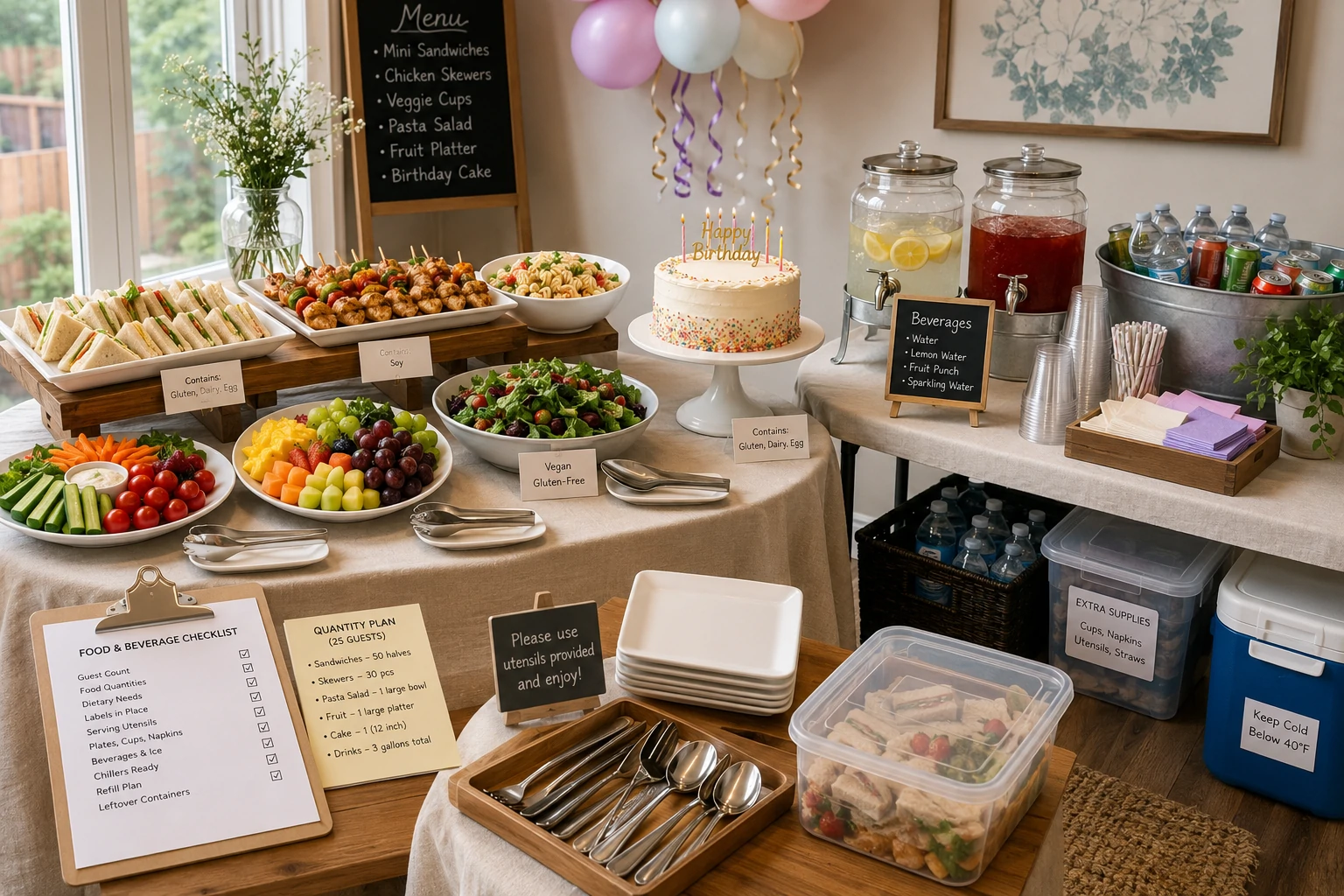
Use the Four-Part Menu Test
Plan Quantities Without Creating Excessive Waste
Use expected attendance, not the total number invited. Add a modest buffer for last-minute guests and serving variation, but do not order as though every invitee will arrive hungry at the same moment.
| Party format | Starting planning estimate | Adjustment factors |
|---|---|---|
| Light snack party | Several small portions per guest plus cake | Increase for longer events or events scheduled over a normal meal time. |
| Buffet meal | One complete serving per confirmed guest plus a modest buffer | Offer fewer mains and more flexible sides instead of too many dishes. |
| Children’s party | Smaller portions with familiar options | Account for accompanying adults and age differences. |
| Dessert-focused party | One primary dessert plus one or two small alternatives | Provide fruit or a lighter option for guests who do not want cake. |
- Confirm dietary restrictions.
- Label common allergens clearly.
- Separate raw and ready-to-eat preparation.
- Plan hot holding and cold storage.
- Place drinks away from the food queue.
- Provide enough water throughout the event.
- Assign someone to refill and clear the buffet.
- Prepare containers for safe leftovers.
FoodSafety.gov recommends the four basic controls of clean, separate, cook and chill. It also advises refrigerating perishable foods within two hours, or within one hour when exposed to temperatures above 90°F/32°C. Review the official FoodSafety.gov guidance.
Build a Birthday Party Run of Show
A run of show is the minute-by-minute operating plan used by the host, helpers and vendors. Guests do not need to see it. Its purpose is to prevent the cake, entertainment, food service and photographs from competing for the same time.
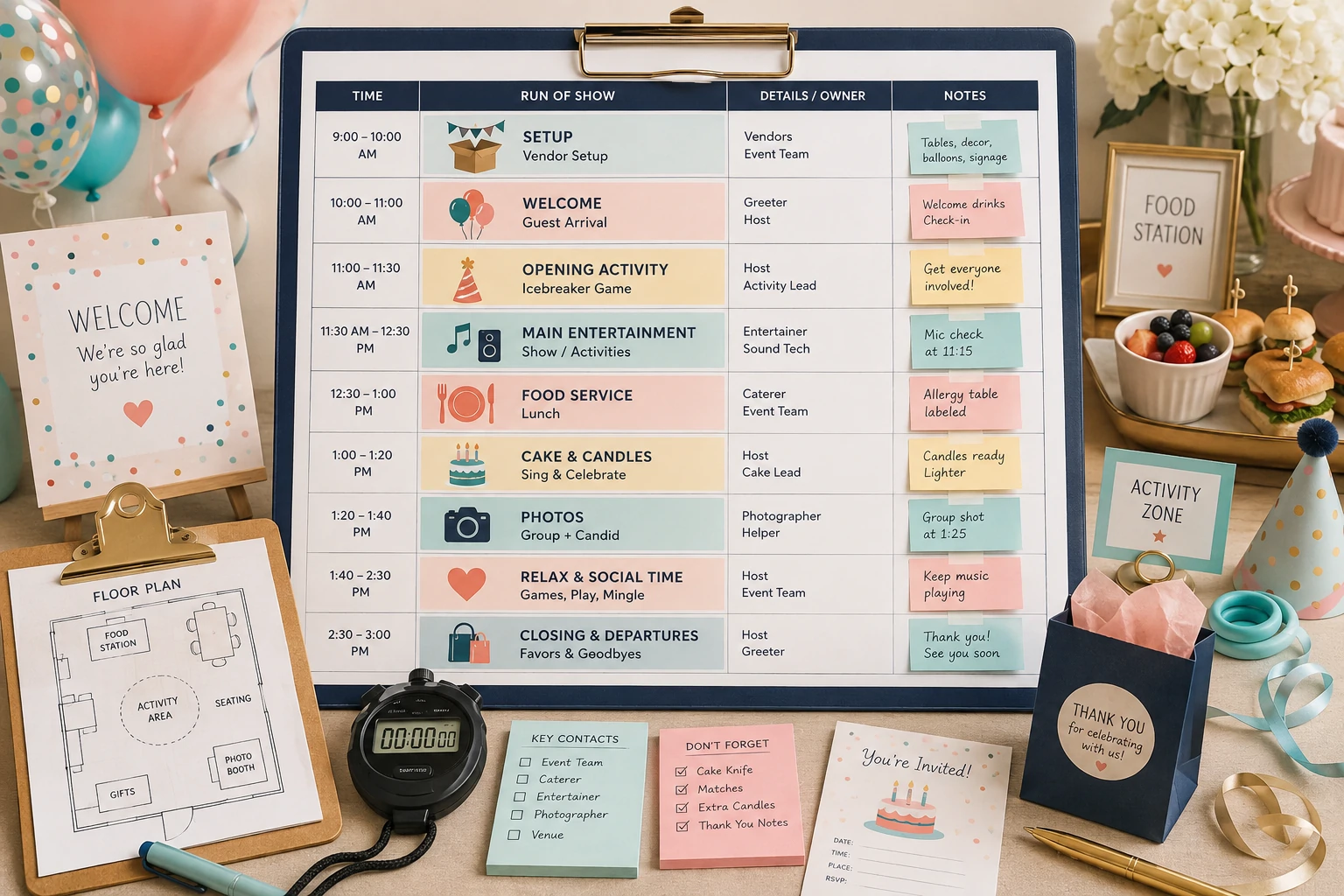
| Time | Guest experience | Operational action | Owner |
|---|---|---|---|
| –120 minutes | Guests not yet present | Vendor access, tables, food stations and technical setup | Setup lead |
| –60 minutes | Final environment check | Sound test, restroom check, temperature controls and photography test | Host + leads |
| 0:00 | Arrival and welcome | Direct gifts, coats, parking questions and first drinks | Welcome helper |
| 0:20 | Opening activity or conversation | Begin food service and monitor guest flow | Activity + food leads |
| 0:50 | Main entertainment or activity | Prepare cake area and gather required people | Entertainment lead |
| 1:20 | Cake, candles and photographs | Lower music, position photographer and protect the cake route | Host + photo lead |
| 1:40 | Relaxed social time | Refresh drinks, begin discreet clearing and prepare favors | Food + exit leads |
| 2:00 | Closing and departures | Distribute favors, help with transport and secure gifts | Exit helper |
Delegate Outcomes, Not Vague Help
“Can you help at the party?” is too unclear. Give each helper a specific outcome, start time and authority level.
Plan Birthday Photographs and Memories Before the Party
“Take lots of pictures” is not a photography plan. Decide which images matter, when they can be captured and who is responsible.
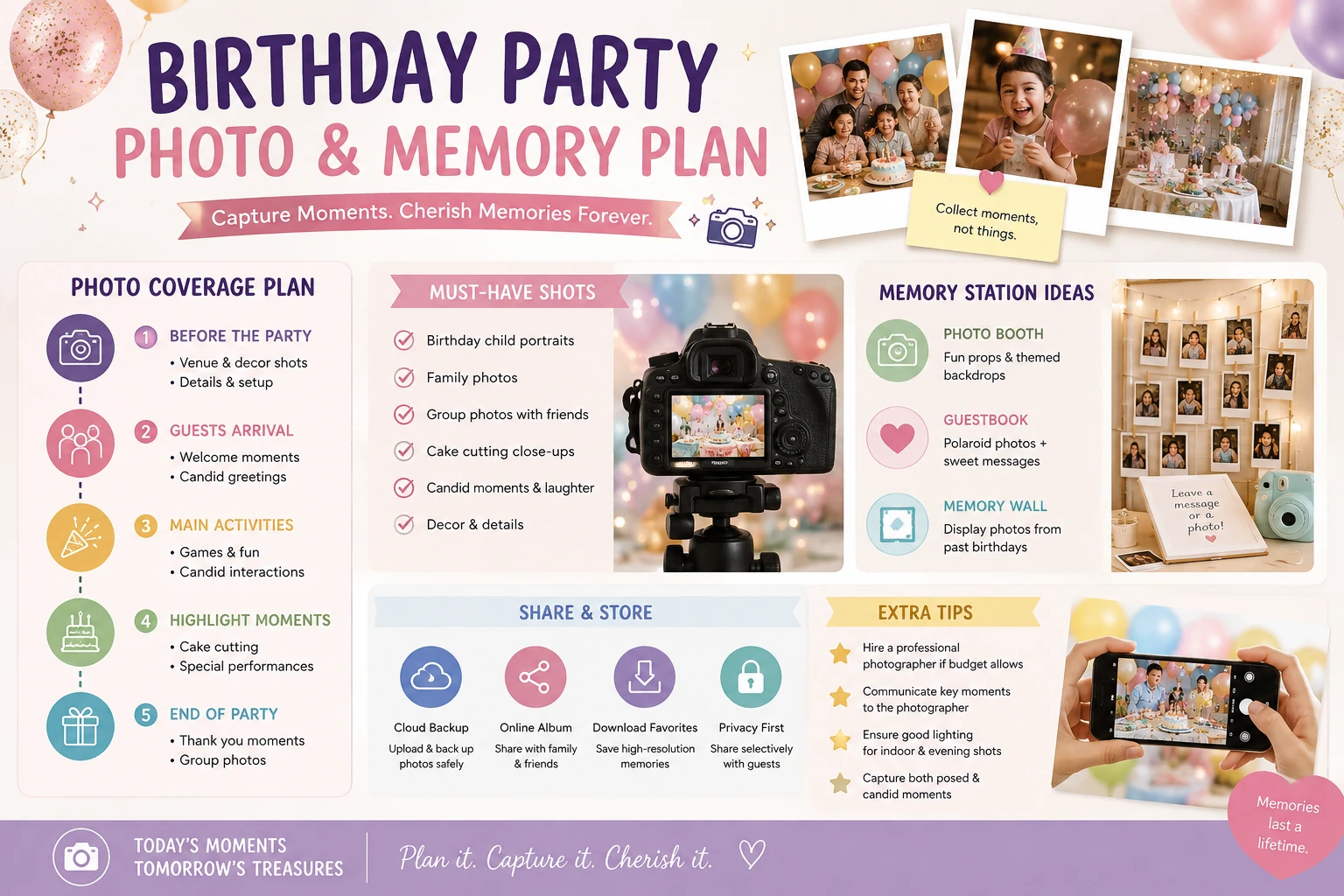
- Guest of honor before the room becomes busy.
- Immediate family or closest friends.
- Generational or milestone groupings.
- The completed setup before guests arrive.
- Cake and candle moment.
- One wide photograph showing the atmosphere.
- Activities and natural guest reactions.
- One clean portrait for a frame or thank-you card.
Schedule the most important group photograph early enough that guests are still present and the guest of honor still looks comfortable. Keep the photo area close to the celebration but outside the main food and traffic route.
Use One Photo Set Across Frames, Collages and Thank-You Designs
After the party, select a small group of strong photographs instead of leaving hundreds of images unorganized. The Birthday template collection on MRRFrame includes birthday photo booth frames, collages, invitations, greeting cards, party designs and milestone layouts that can turn those photographs into something guests can revisit and share.
Use the same image set for: a birthday collage, social post, photo greeting, thank-you card or milestone memory board.
Best workflow: shortlist the clearest photographs, choose the right format, place the images and add only essential names or dates.
Explore Birthday Photo Frame TemplatesBuild a Contingency Plan Before You Need It
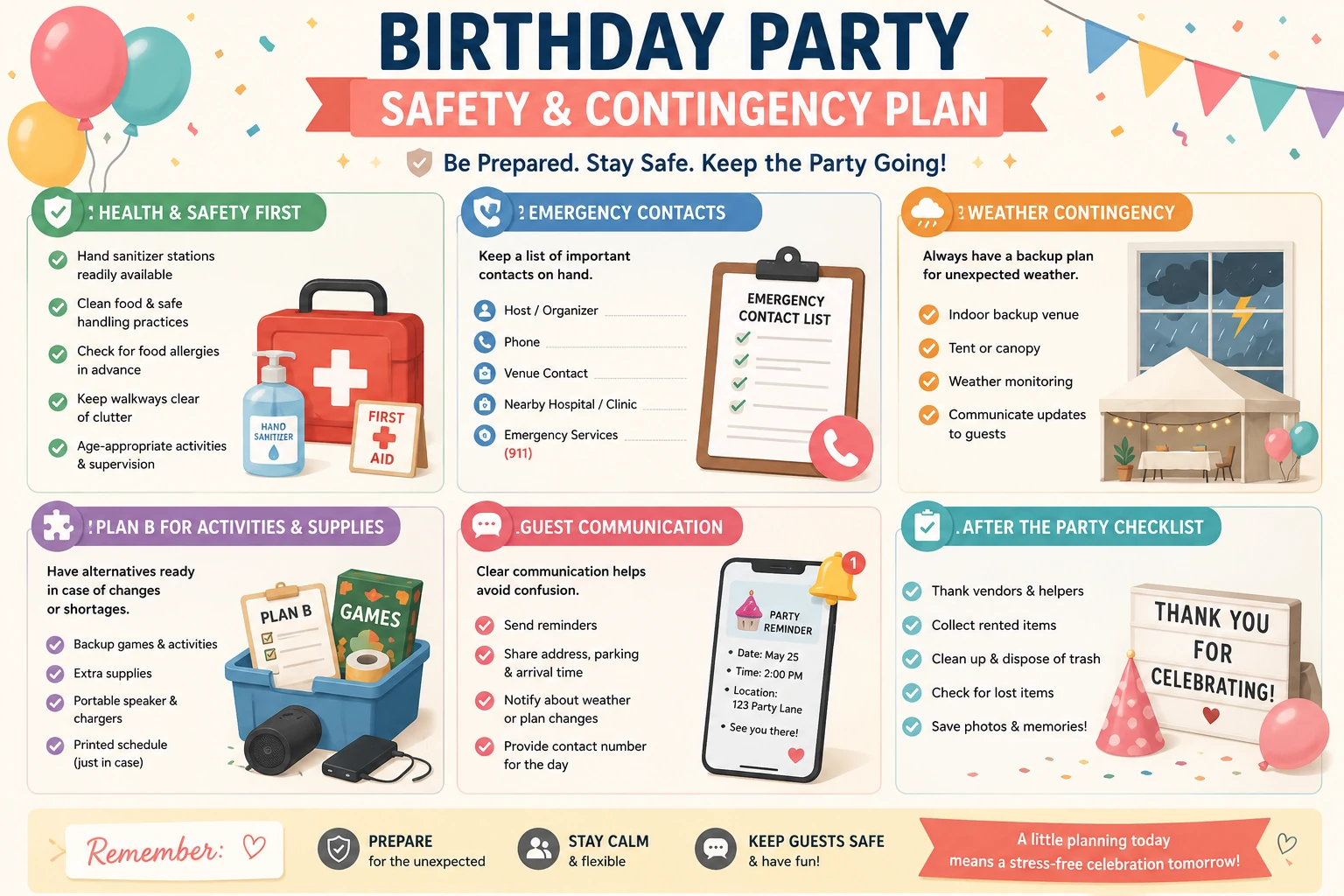
Professional planning assumes that at least one part of the original plan will change. A backup plan is not pessimism; it is the mechanism that keeps a small disruption from controlling the entire event.
| Risk | Decision trigger | Backup action | Decision owner |
|---|---|---|---|
| Rain or extreme heat | Forecast crosses the agreed threshold | Move indoors, rent cover or shorten outdoor activities | Host |
| Vendor delay | No arrival confirmation by deadline | Start simplified internal setup and contact backup supplier | Vendor lead |
| Guest count increase | Attendance exceeds seating or food buffer | Add flexible seating and simplified food portions | Guest lead |
| Power or sound failure | Equipment fails during final test | Use charged portable speaker and offline playlist | Technical helper |
| Guest of honor overwhelmed | Visible stress, fatigue or sensory overload | Pause the schedule and use the prepared quiet space | Trusted family member |
| Minor injury or spill | Immediate safety issue | Pause the affected zone, provide first aid or clean the hazard | Safety helper |
Safety Details That Belong in the Plan
- Keep exits and walkways clear.
- Secure cords, rugs and backdrop stands.
- Place sharp tools outside guest reach.
- Keep hot drinks away from children.
- Check outdoor lighting and steps.
- Store cleaning chemicals securely.
- Identify the first-aid kit location.
- Assign adult supervision for child activity zones.
The U.S. Fire Administration recommends keeping lit candles in stable holders, at least 12 inches from anything that can burn, and extinguishing them whenever the room is unattended. It also suggests considering battery-operated flameless candles. Read the official candle fire-safety guidance.
The Complete Day-of Birthday Party Checklist
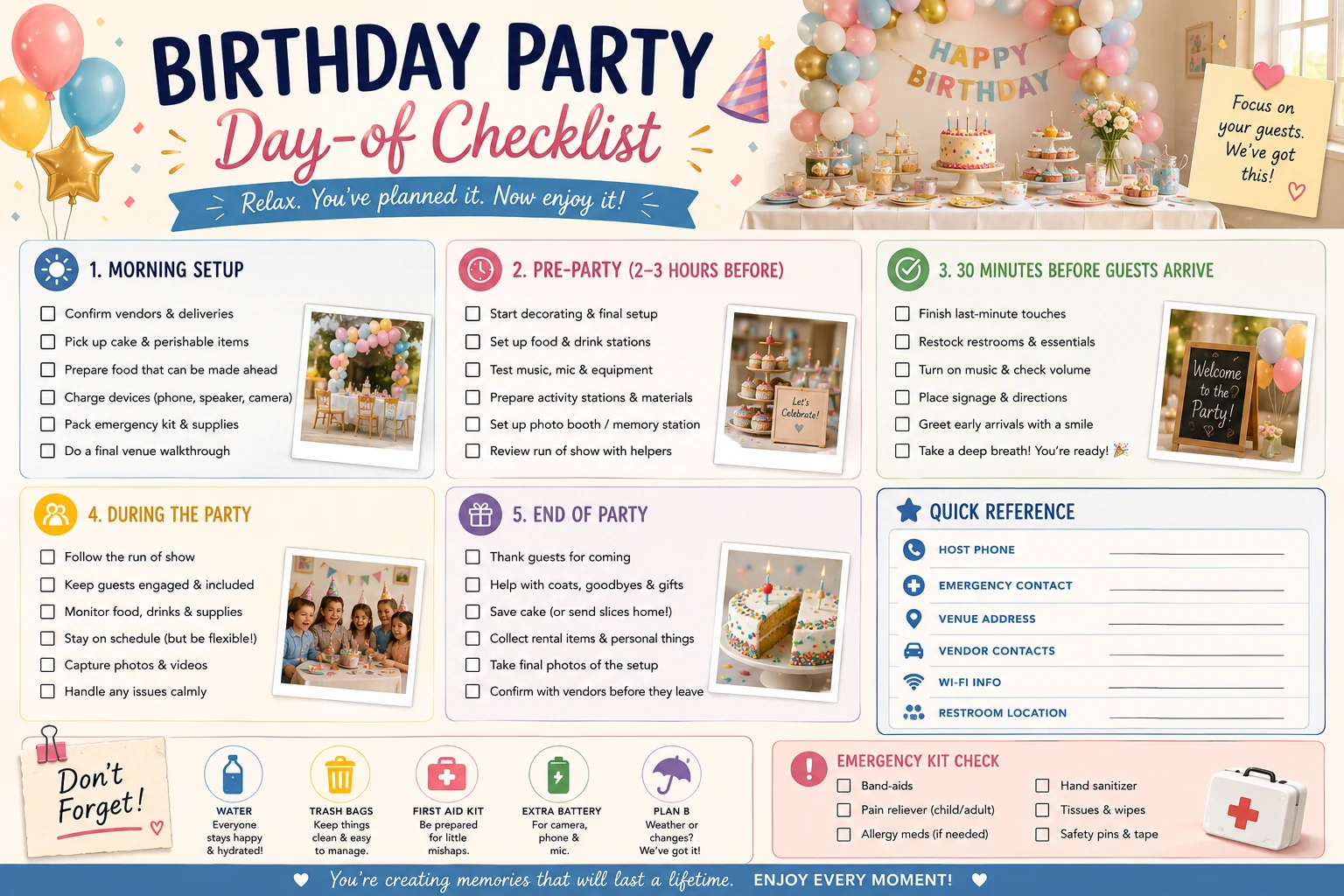
Four Hours Before
- Open the venue and check temperature, power and restrooms.
- Confirm the floor plan and clear all guest routes.
- Receive rentals and verify quantities.
- Set tables, seating and major decorations.
- Place food and activity equipment without opening perishables.
- Check emergency contacts and vendor status.
Two Hours Before
- Complete food preparation and temperature controls.
- Set drinks, ice, labels, utensils and napkins.
- Test music, microphones and lighting.
- Photograph the completed room.
- Place gifts, coats, favors and waste stations.
- Brief helpers using the run of show.
Thirty Minutes Before
- Remove packaging and visible setup tools.
- Check mirrors, restrooms and entrance lighting.
- Put the guest of honor in a calm, comfortable space.
- Start the arrival playlist.
- Place the welcome helper at the entrance.
- Stop making optional changes.
During the Party
- Follow the major transitions, not every minute rigidly.
- Monitor food, drinks and guest flow.
- Protect the cake and essential photo timing.
- Adjust activities based on energy and participation.
- Clear hazards and spills immediately.
- Keep one person free to support the guest of honor.
Closing and After the Party
- Distribute favors and help guests collect belongings.
- Secure gifts, cards and personal items.
- Refrigerate safe leftovers promptly.
- Photograph rental items before return.
- Back up photographs and videos.
- Send thank-you messages within several days.
- Record what worked while the event is still fresh.
- Close the final budget and recover deposits.
Common Birthday Party Planning Mistakes
Frequently Asked Questions About a Birthday Party Planning Checklist
How Far in Advance Should I Plan a Birthday Party?
For most home, restaurant and small-venue parties, four to eight weeks is practical. Large milestone celebrations, popular venues and events requiring multiple vendors may need three to six months.
What Should I Book First?
Book the items with limited availability and the greatest effect on the rest of the plan: the venue, entertainment, catering, photographer and major rentals. Decorations should come later.
How Much Contingency Money Should I Keep?
A planning reserve of roughly 8–12% is a useful starting point for delivery fees, replacement items, weather changes and overtime. Increase it when the party depends heavily on outdoor conditions or multiple vendors.
How Do I Plan a Party in Less Than Two Weeks?
Reduce the number of moving parts. Use a home or restaurant format, digital invitations, a focused guest list, a simple menu, one activity and one decorated focal area. Avoid custom items with uncertain delivery times.
What Is the Most Important Day-of Document?
The run of show is the central document because it combines timing, locations, operational actions and ownership. Keep the vendor contacts, floor plan and emergency information attached to it.
How Can I Keep the Party From Feeling Overplanned?
Plan the structure behind the scenes while leaving flexible social time for guests. A professional plan protects the experience; it should not make attendees feel managed.
Final Thoughts on the Complete Birthday Party Planning Checklist
A successful birthday party is not the one with the most decorations or the longest activity list. It is the one in which the guest of honor feels celebrated, guests understand what to do, food and spaces function properly, important moments are preserved and the host has enough support to participate.
Start with the event brief, protect the budget, plan the guest journey, work backward from the date and assign ownership before the party begins. When those systems are clear, the creative decisions become easier—and the celebration feels thoughtful rather than complicated.
The quantity ranges and budget percentages in this guide are planning starting points, not universal requirements. Adjust them for guest ages, event format, local costs, venue rules and professional advice relevant to your celebration.