
Birthday Party Themes for Kids Based on Their Interests: 15 Ideas That Actually Fit the Child
The best birthday party theme is not the one trending hardest on social media. It is the one that makes a child walk into the room and immediately feel, “This is mine.” A dinosaur-loving four-year-old may care more about digging for fossils than a perfect balloon arch. A nine-year-old artist may remember the canvas they painted with friends long after the cake is gone. A tween who loves gaming may want a tournament bracket and team challenge—not cartoon decorations.
That is why this guide starts with the child’s interests and builds outward. Instead of giving you a giant list of themes with no planning logic, it shows how to turn a real interest into a complete party system: decor, activities, food, timing, guest flow, take-home items and photo moments. It also explains which ideas work better at different ages, how to keep the party flexible and what to simplify when the budget or space is limited.
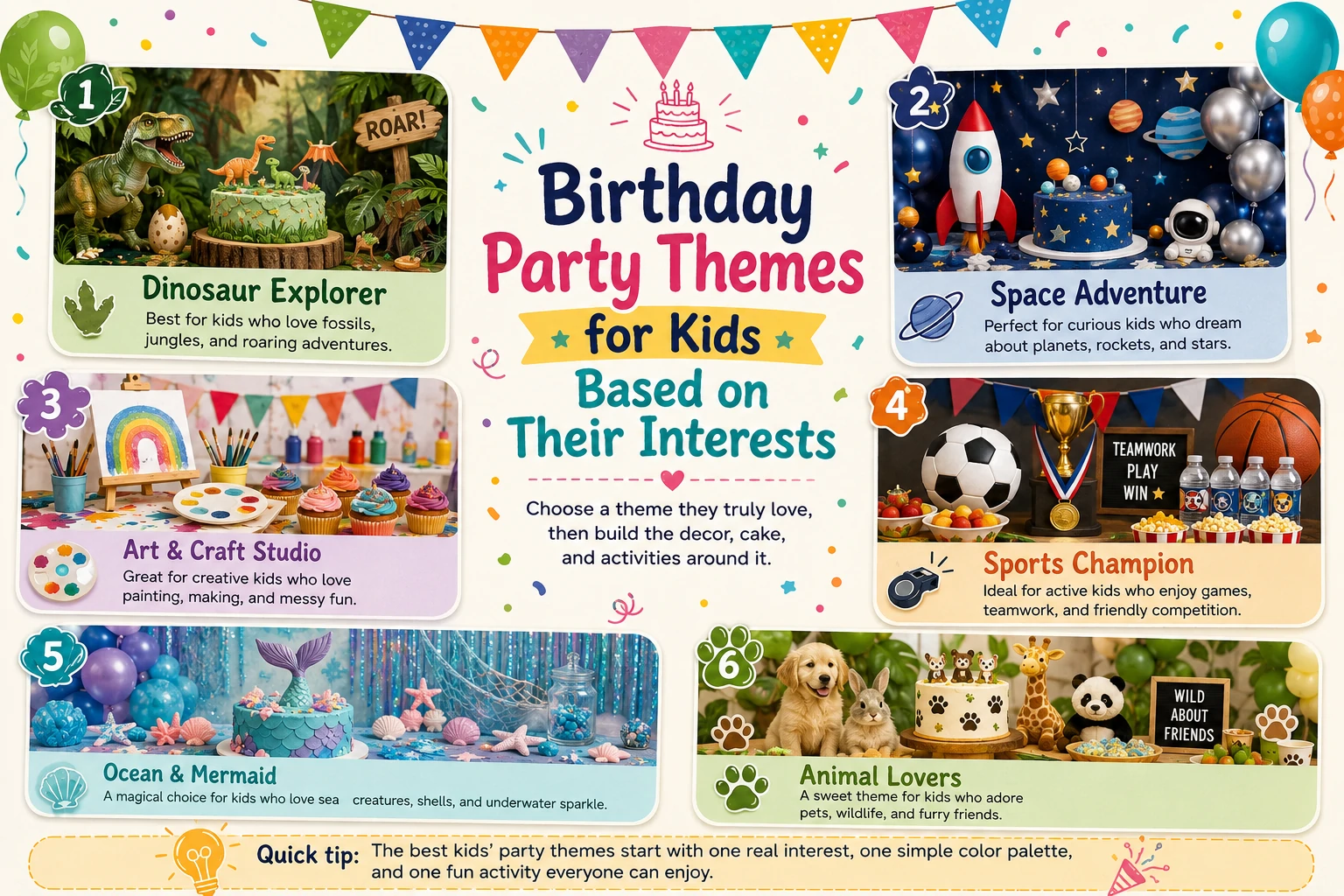
Ask three questions: What do they choose when nobody suggests an activity? What do they talk about repeatedly? What kind of play makes them lose track of time? The overlap usually reveals a stronger theme than asking, “What party do you want?” from a blank page.
Choose a Birthday Theme From the Child, Not the Decoration Aisle
A theme becomes easier to plan when it comes from a real behavior instead of a visual trend. “Blue and gold space party” is a look. “This child spends every afternoon drawing planets and asking how rockets work” is a planning direction. The second version tells you what activity to choose, what story to build and what the child may actually enjoy.
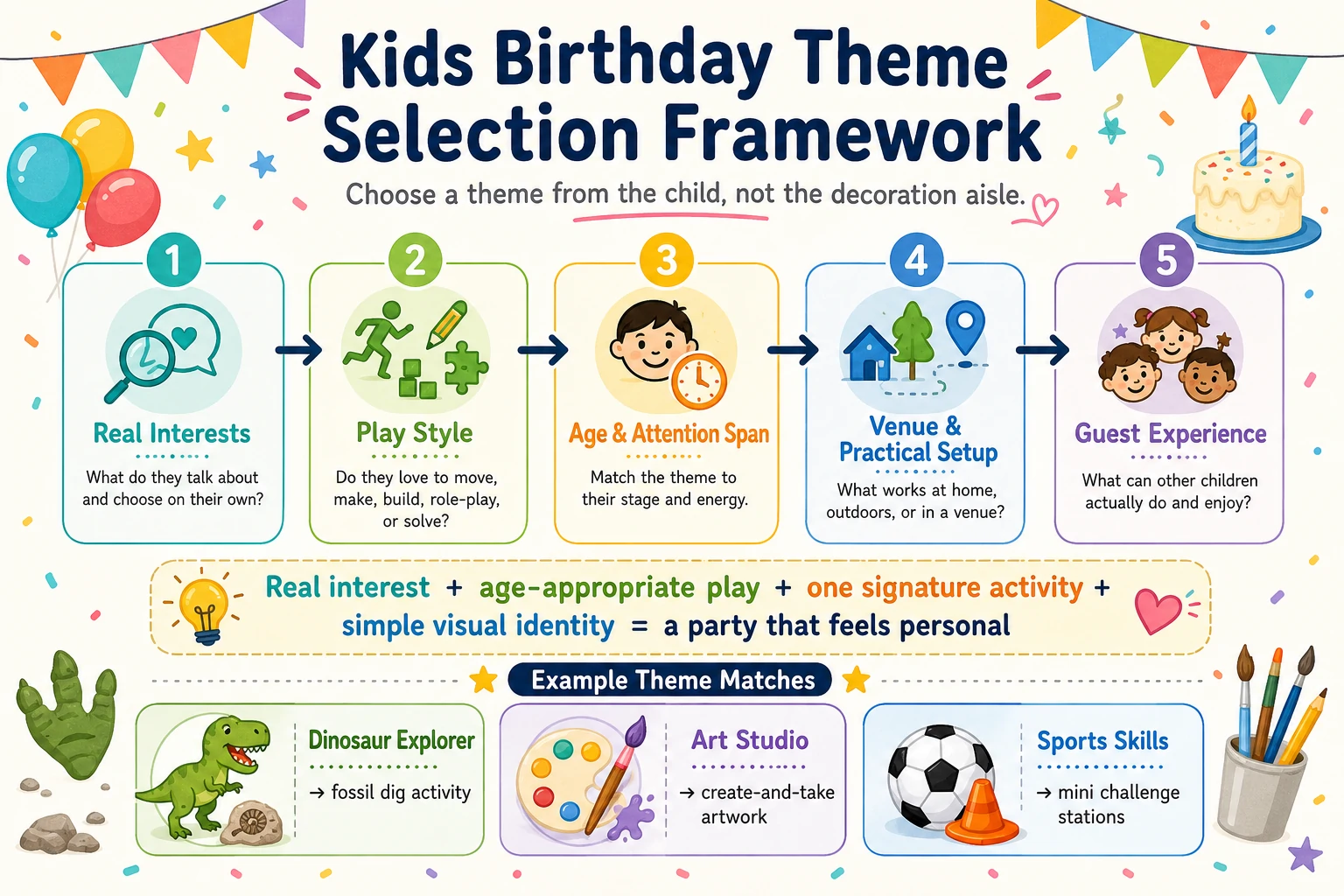
The Five-Question Theme Test
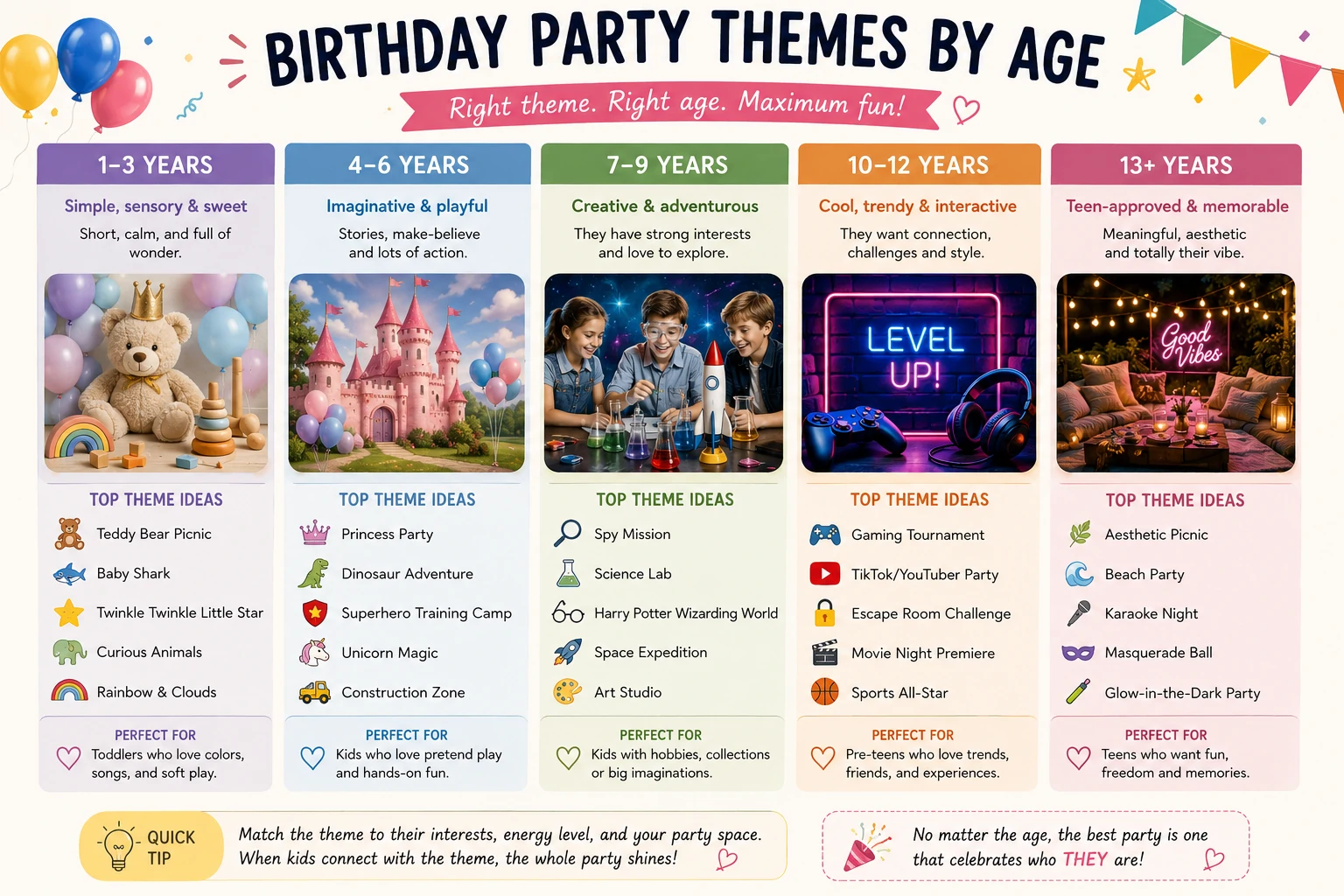
Match Birthday Party Themes to Age and Attention Span
Age does not determine interests, but it changes how a party should be structured. The American Academy of Pediatrics notes that young children generally do better with shorter celebrations, while school-age children can handle longer parties. Their guidance also recommends planning activities in short blocks for young children while remaining flexible when a game is going especially well.
15 Birthday Party Themes for Kids Based on Their Interests
The ideas below are designed as party systems rather than decoration labels. Each theme includes the child it suits, one signature activity, a food direction and a photo moment that naturally fits the experience.
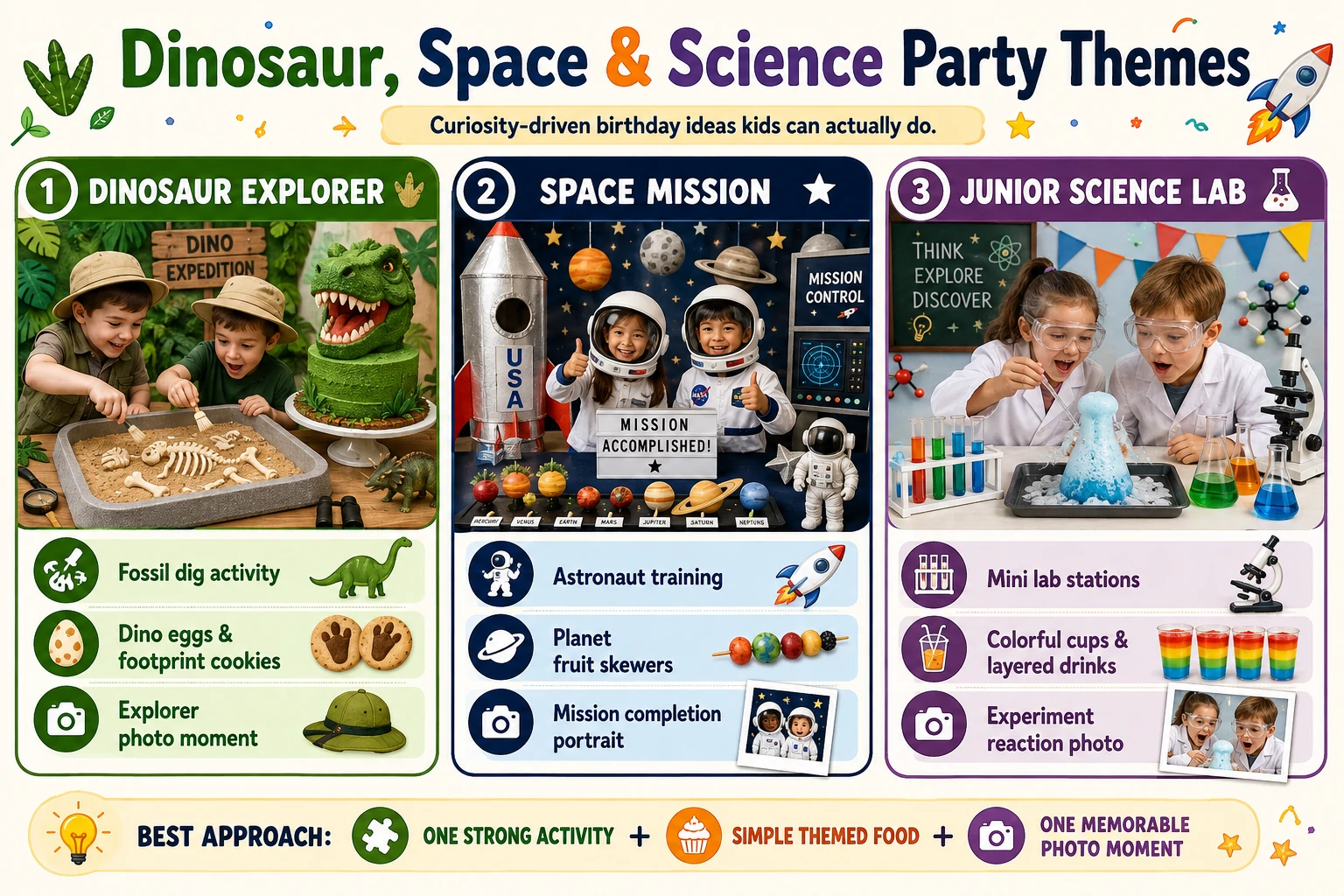
1. Dinosaur Explorer Party
Perfect for children who know dinosaur names better than most adults. Build the party around exploration rather than simply covering the room with dinosaur graphics.
Create a fossil dig using kinetic sand or a supervised sandbox, hide large “bones,” add a footprint trail and let children classify discoveries at an explorer table. Older children can complete a timed dig or match fossils to dinosaur cards.
2. Space Mission Party
Choose this for a child fascinated by planets, rockets or astronauts. Give guests a mission rather than only a starry backdrop: build a paper rocket, navigate a planet course or complete small “astronaut training” stations.
Use dark navy, silver and one bright accent rather than every galaxy color at once. A simple cardboard rocket or mission-control sign can anchor the room.
3. Junior Science Lab
A science party works when the experiments are short, visible and reliable. Choose two or three activities you have already tested instead of scheduling ten complicated demonstrations.
Color mixing, safe density experiments, paper engineering challenges or simple slime-making can work depending on age and supervision. Prepare materials in individual trays before guests arrive.
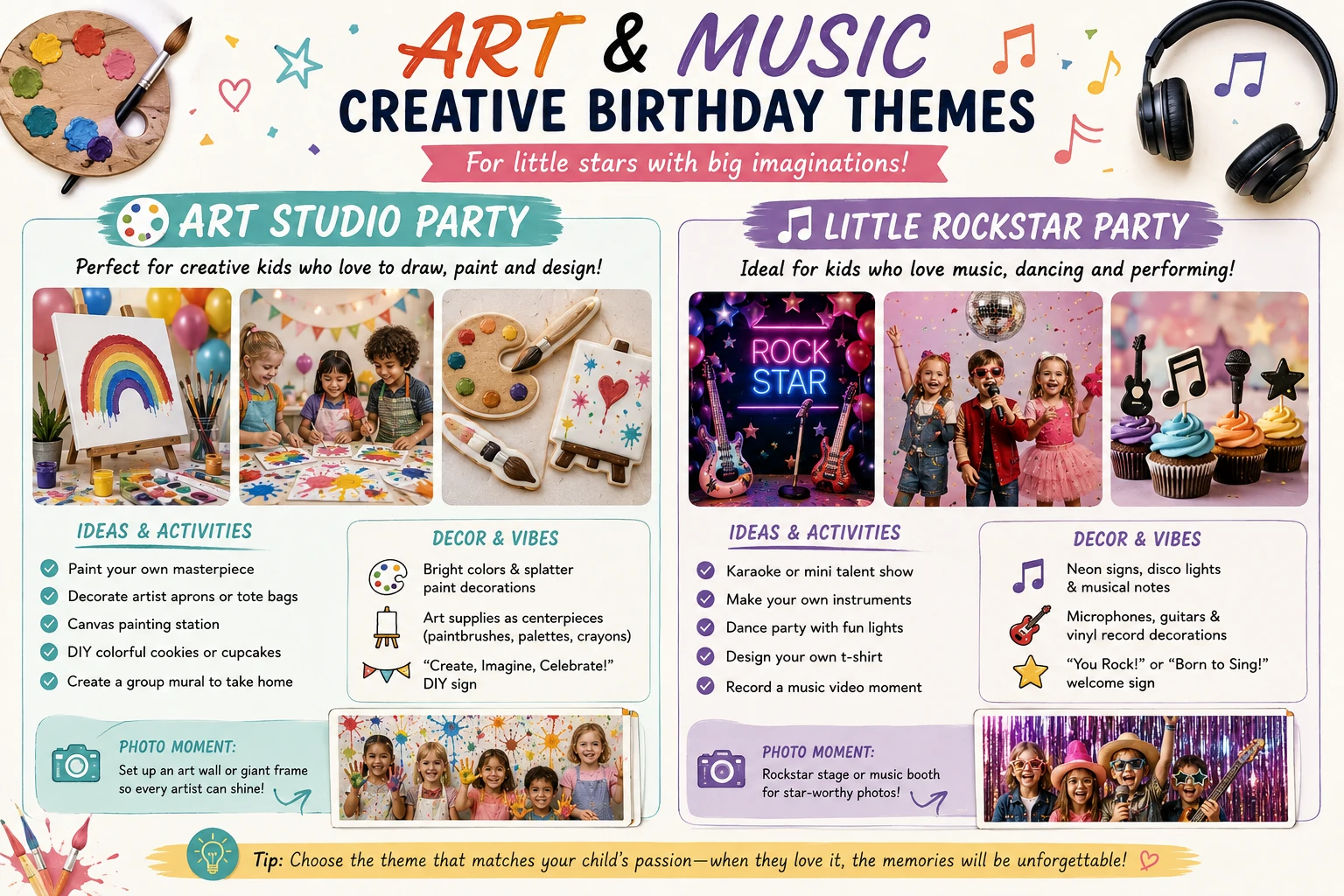
4. Art Studio Party
For a child who is happiest drawing, painting or making things, transform the party into a working studio. Give every guest a small canvas, watercolor card, tote bag or collaborative mural section.
Limit the color palette of the decor so the children’s artwork becomes the visual energy in the room. Cover tables properly, label materials and create a drying area before the party begins.
5. Music & Dance Party
Use this for children who sing, dance or turn every room into a stage. Create a short playlist with the birthday child, set up a dance challenge, rhythm game or simple karaoke station and include a quiet seating zone for guests who need a break.
For younger children, scarves, freeze dance and call-and-response movement are easier than formal choreography. Tweens may prefer a playlist battle, lip-sync round or dance tutorial.
6. Junior Baker Party
A baking theme is strongest when guests genuinely make something. Pre-measure ingredients for younger children or use decorating rather than full baking when oven logistics are difficult.
Cupcake decorating, cookie design, mini pizza assembly or no-bake treats create participation without making the host spend the whole party managing a kitchen.
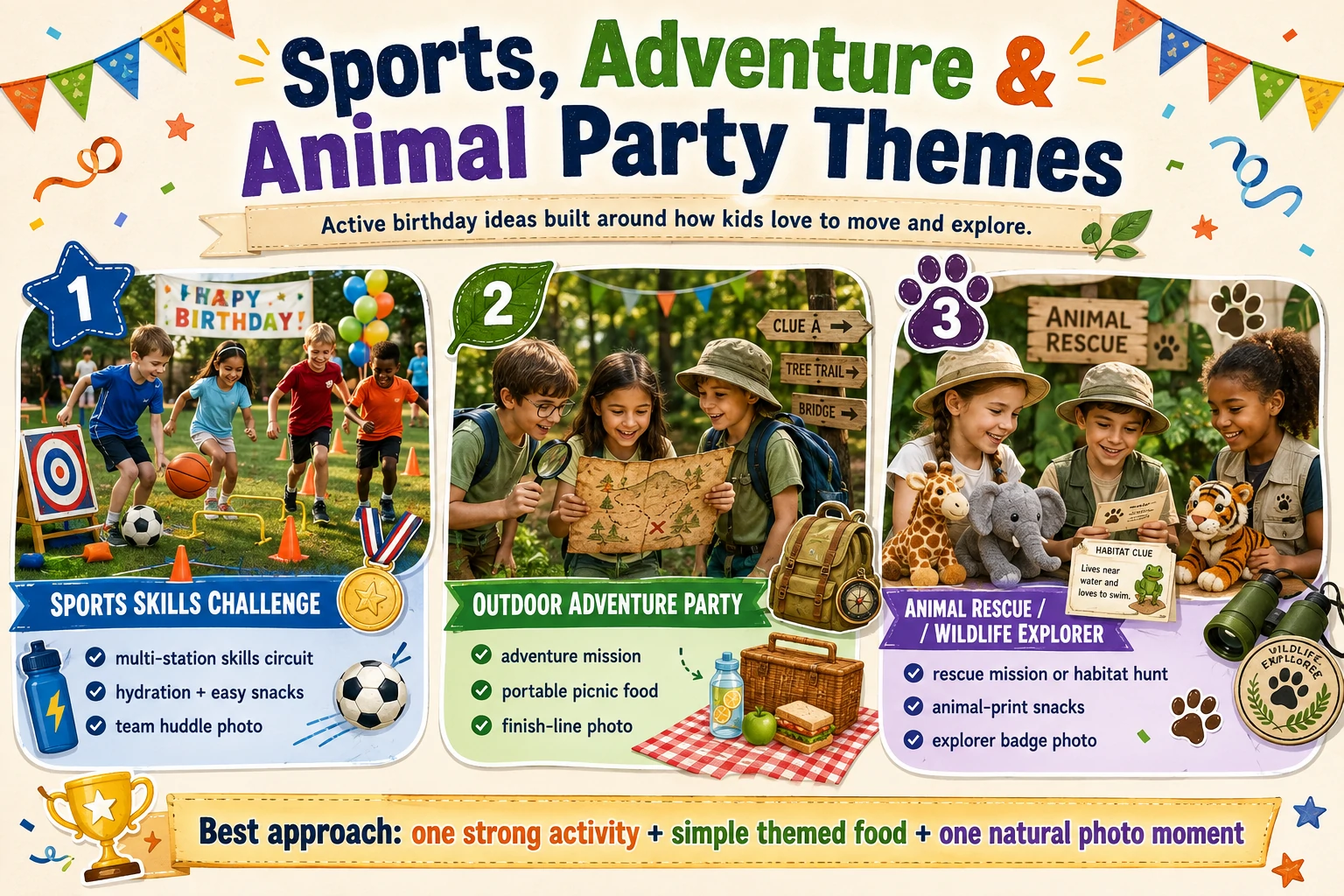
7. Sports Skills Challenge
Build the party around the sport the child actually plays or watches. Instead of one long competitive match, use stations: target kick, dribble course, throwing accuracy, relay, trick-shot corner or team puzzle.
This structure prevents one highly skilled child from controlling the entire party and gives more guests a chance to succeed.
8. Animal Rescue or Wildlife Explorer Party
Choose animals the child truly loves rather than mixing every species into one generic jungle. A pet lover might enjoy a pretend rescue center; a wildlife fan may prefer animal tracks, habitat matching or a nature scavenger hunt.
If a real animal encounter is involved, use a reputable provider and let animal welfare, hygiene and guest comfort take priority over the photo opportunity.
9. Outdoor Adventure Party
For kids who prefer climbing, running and exploring, let the location do much of the decorating. A park, garden or safe trail can support scavenger hunts, obstacle courses, nature bingo or team missions.
Prepare a weather backup and establish boundaries before the first game begins. Outdoor parties also need visible water, sunscreen planning and shade when appropriate.
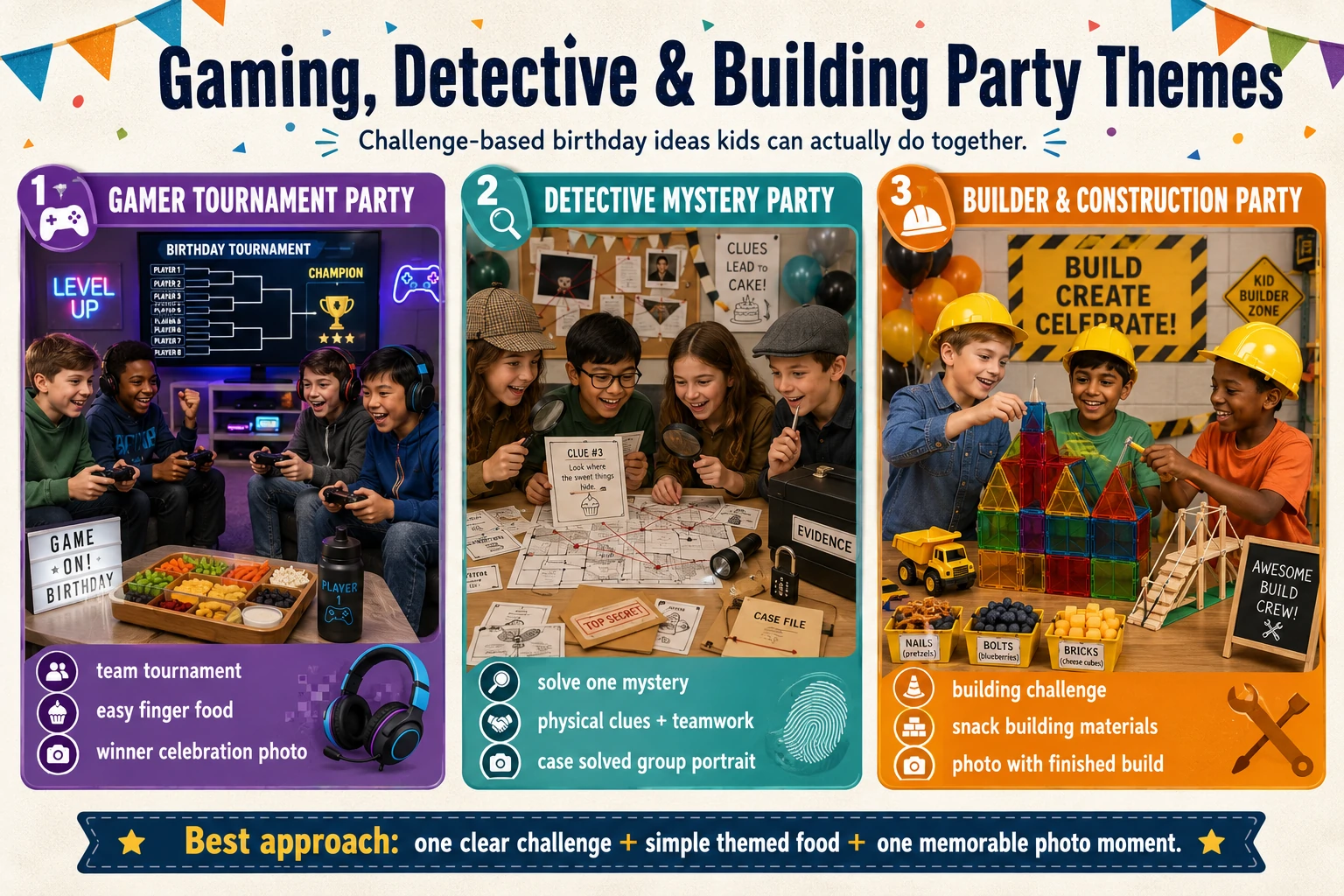
10. Gamer Tournament Party
Gaming works best when the guest list and equipment match. Decide whether the party is built around one multiplayer game, several short rounds or a mix of screen and offline challenges.
Create a bracket, rotate teams and plan something for children waiting between rounds. For younger guests, cooperative games often produce a better atmosphere than elimination.
11. Detective Mystery Party
Give guests a case to solve: missing birthday cake, secret treasure, mysterious footprint or coded message. Build the mystery from five to seven clues so the experience feels solvable rather than frustrating.
Use physical clues, simple ciphers, observation and teamwork. The final clue should lead directly into cake, favors or another satisfying party moment.
12. Builder & Construction Party
Ideal for children who constantly build with blocks, magnetic tiles, cardboard or model kits. Turn the room into a challenge studio instead of relying only on yellow-and-black construction decor.
Teams can build the tallest tower, strongest bridge, marble run or cardboard city. Photograph the structures before the children dismantle them.
13. Ocean Explorer Party
Use an ocean theme for a child interested in sea animals, coral reefs, submarines or mermaids, then decide which direction is actually theirs. An ocean-science child may enjoy species matching; a fantasy-loving child may prefer treasure, shells and imaginative play.
This distinction keeps the theme personal instead of assuming every ocean-loving child wants the same aesthetic.
14. Storybook Adventure Party
Choose a favorite type of story—dragons, fairies, wizards, explorers, detectives or magical forests—and create an original adventure around it. This avoids making the entire party dependent on one licensed character while still preserving the child’s favorite kind of imaginary world.
Guests might collect tokens, follow a map, decorate a crown or shield, solve a riddle and finish with a story-circle photo.
15. Movie Night or Cozy Cinema Party
For older children and tweens who prefer hanging out to organized games, a cinema party can feel mature without becoming complicated. Let the child choose the film in advance, create comfortable seating and add one pre-movie activity such as trivia, photo booth prompts or snack-bar customization.
Do not overload the schedule. The movie is already the main event.
Build Every Kids Party Theme in Five Layers
Once you choose the theme, do not start shopping randomly. Build it in layers. This keeps the party coherent and prevents the decor budget from expanding faster than the experience.
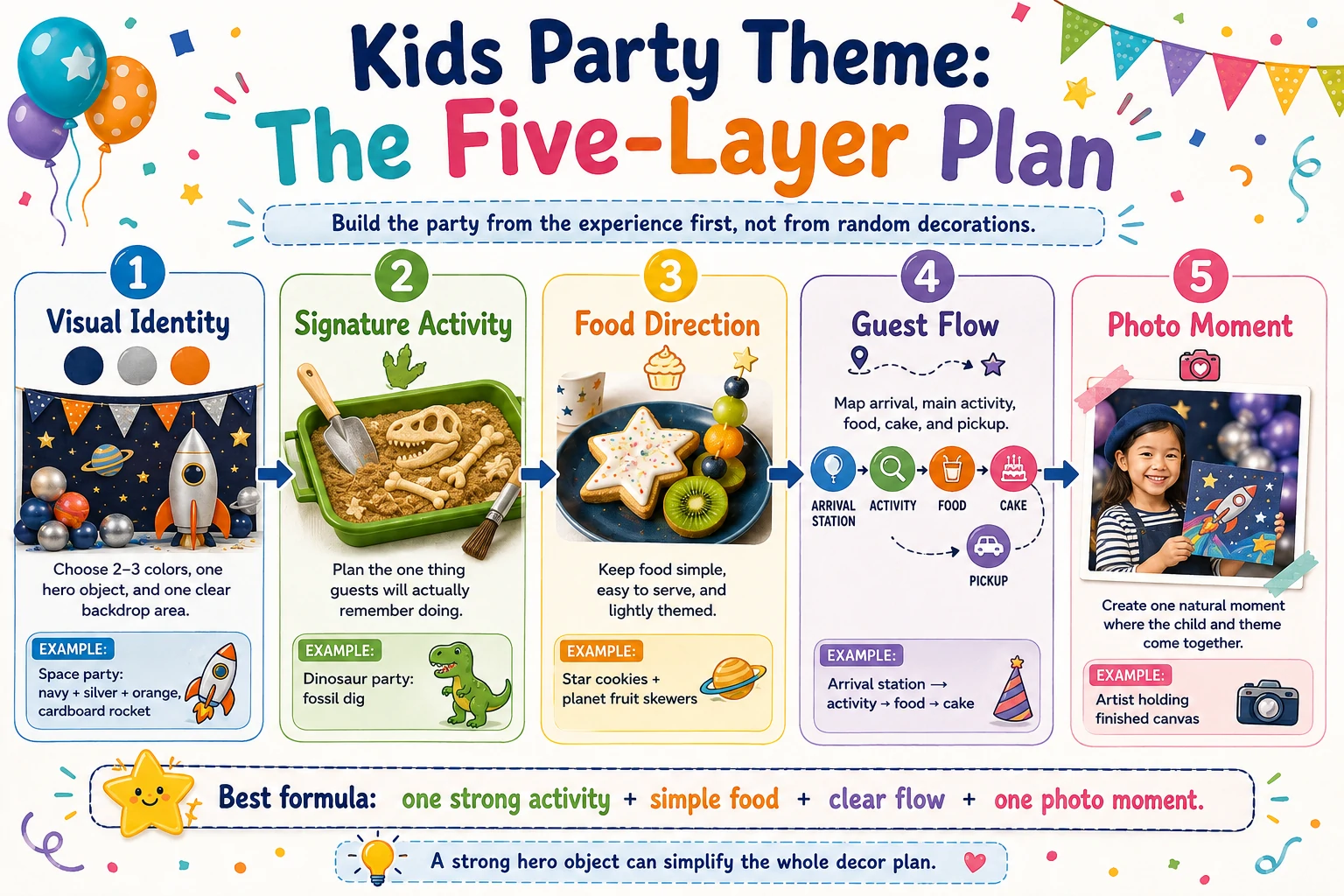
| Layer | What to decide | Good example | What not to do |
|---|---|---|---|
| 1. Visual identity | Two or three colors, one hero object, one backdrop area | Space: navy + silver + orange, cardboard rocket | Buy every matching item available |
| 2. Signature activity | The thing guests will actually remember doing | Dinosaur fossil dig | Schedule six unrelated games |
| 3. Food direction | Easy food with one or two theme references | Planet fruit skewers and star cookies | Rename every ordinary snack with confusing labels |
| 4. Guest flow | Arrival, main activity, food, cake, free play, pickup | Activity stations that open as guests arrive | Leave ten children waiting for the host to begin |
| 5. Photo moment | One natural point where the theme and child meet | Artist holding finished canvas | Force repeated posed photos during play |
Plan the Birthday Party Activity Flow Before the Decorations
A beautiful theme cannot rescue a party with too much waiting. Younger children especially benefit from a simple rhythm: arrive, do something immediately, move into the main activity, eat, celebrate and finish before energy collapses.
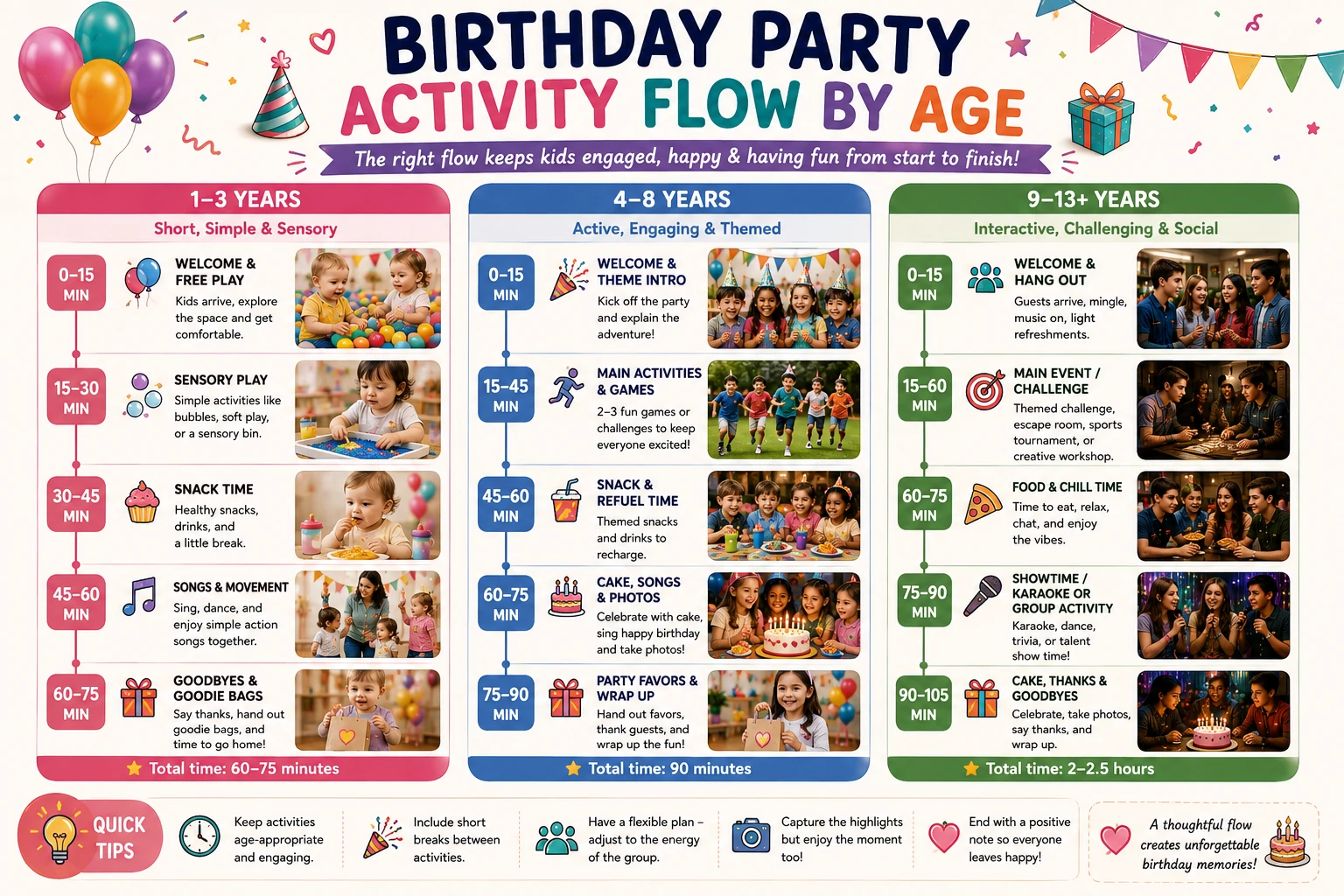
Sample 90-Minute Preschool Party
| Time | Plan | Purpose |
|---|---|---|
| 0–15 min | Open play or simple arrival activity | No child has to wait for everyone else |
| 15–30 min | Signature activity #1 | Uses fresh attention |
| 30–45 min | Movement game or free play | Changes energy |
| 45–60 min | Food and drinks | Creates a natural reset |
| 60–75 min | Cake, birthday song and photo | Creates the central celebration moment |
| 75–90 min | Simple finish activity and pickup | Avoids ending at peak chaos |
Sample Two-Hour School-Age Party
| Time | Plan | Purpose |
|---|---|---|
| 0–20 min | Arrival station | Guests join gradually |
| 20–50 min | Main challenge or workshop | Delivers the theme promise |
| 50–70 min | Food | Rest and social time |
| 70–95 min | Second activity, team challenge or free choice | Adds variety without overload |
| 95–110 min | Cake and group photo | Celebration peak |
| 110–120 min | Wrap-up and favors | Creates a clear ending |
The American Academy of Pediatrics’ HealthyChildren.org recommends keeping activities for young children in roughly 10–15 minute segments while remaining flexible if they are deeply engaged. See its playful birthday party guidance for young children.
Design Birthday Photo Moments Into the Experience
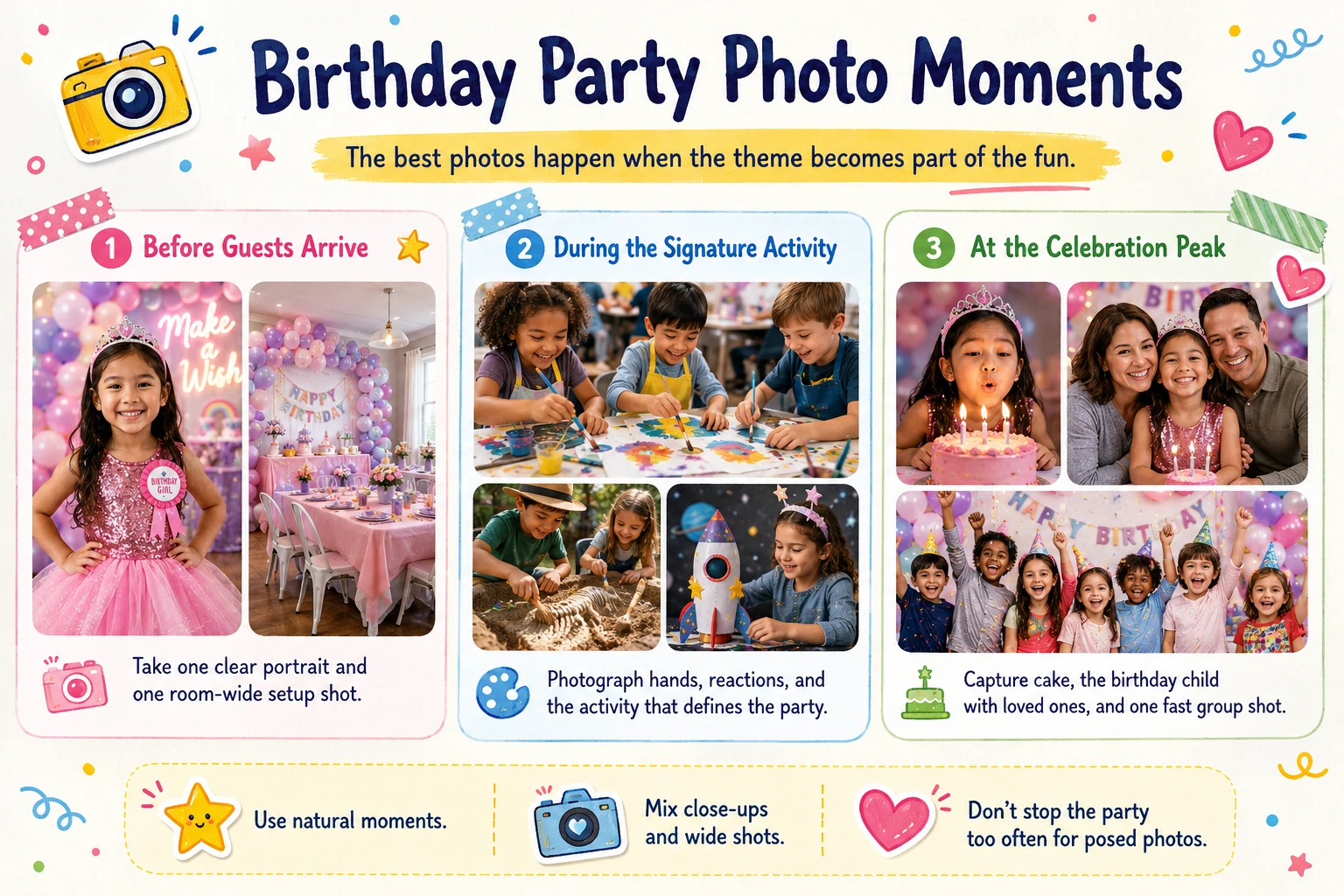
Do not stop the party every twenty minutes for posed pictures. Instead, identify a few moments where the theme naturally creates a photograph: the astronaut receives a mission badge, the artist holds a canvas, the detective solves the case, the baker presents a cupcake or the sports team huddles together.
Use the Theme Again After the Party
A strong party theme gives you more than decoration—it gives the birthday photos a visual identity. After the celebration, choose one hero portrait, one activity photo and one image with friends or family to create a birthday frame, digital thank-you image or memory collage.
The Birthday template collection on MRRFrame gives you ready-made layouts where you can upload party photographs, adjust the crop and add a birthday message without rebuilding a design from scratch.
Best approach: match the template to the party’s color palette, but keep the child’s face and activity images more important than decorative graphics.
Explore Birthday Photo TemplatesMake a Kids Birthday Theme Work on Any Budget
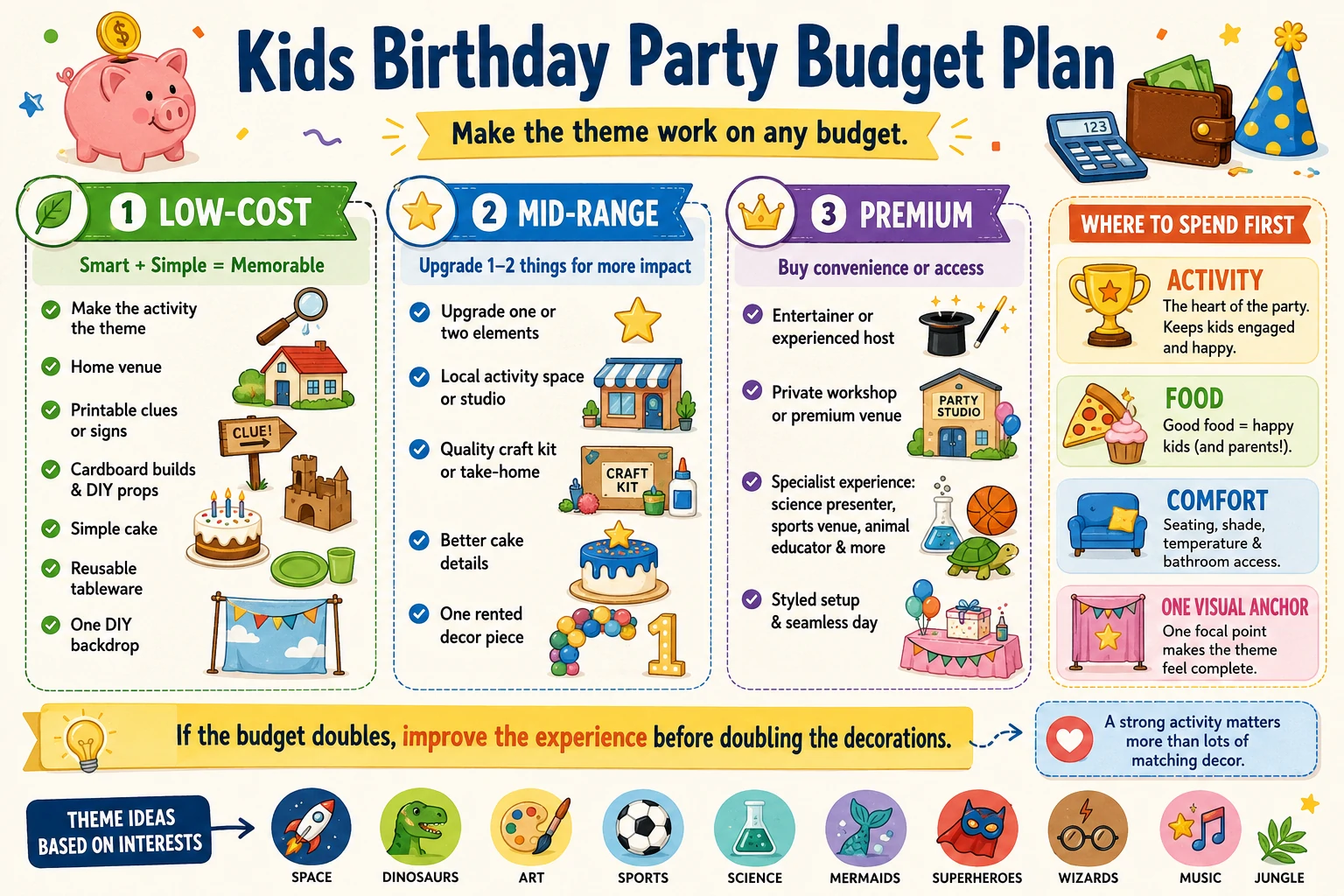
A theme does not become stronger because more objects match it. Spend first on the activity, food, comfort and one visual anchor. Decorative repetition is the easiest category to reduce.
Plan the Theme for the Guests You Actually Have
A personalized party should fit the birthday child without making every guest perform the same way. Think about movement, noise, food, waiting, communication and whether participation has only one “correct” form.
- Create an easy entry activity. Coloring, blocks, stickers, simple puzzles or an open craft station help early arrivals join without instruction.
- Offer a quieter option. At loud music, sports or gaming parties, a calm seating area can help children who need a break.
- Avoid elimination as the main structure. Children who lose in the first five minutes should not spend the next hour watching everyone else.
- Ask about food needs in advance. Keep ingredient information available when possible and avoid making one child’s safe food look like a punishment.
- Make physical activities adjustable. Use different distances, targets or roles so children can participate at different ability levels.
- Do not force costumes. Theme-inspired clothing can be optional. Some children dislike masks, face paint, hats or unfamiliar textures.
Balloon and Small-Part Safety
Balloons are common birthday decor, but they are not harmless around small children. The U.S. Consumer Product Safety Commission warns about choking and suffocation risks from uninflated or broken balloons and requires choking-hazard labeling for certain children’s products. If balloons are used around young children, keep uninflated balloons and broken pieces out of reach and remove damaged balloons promptly.
For additional safety information, see the U.S. Consumer Product Safety Commission’s guidance on small parts and choking hazards.
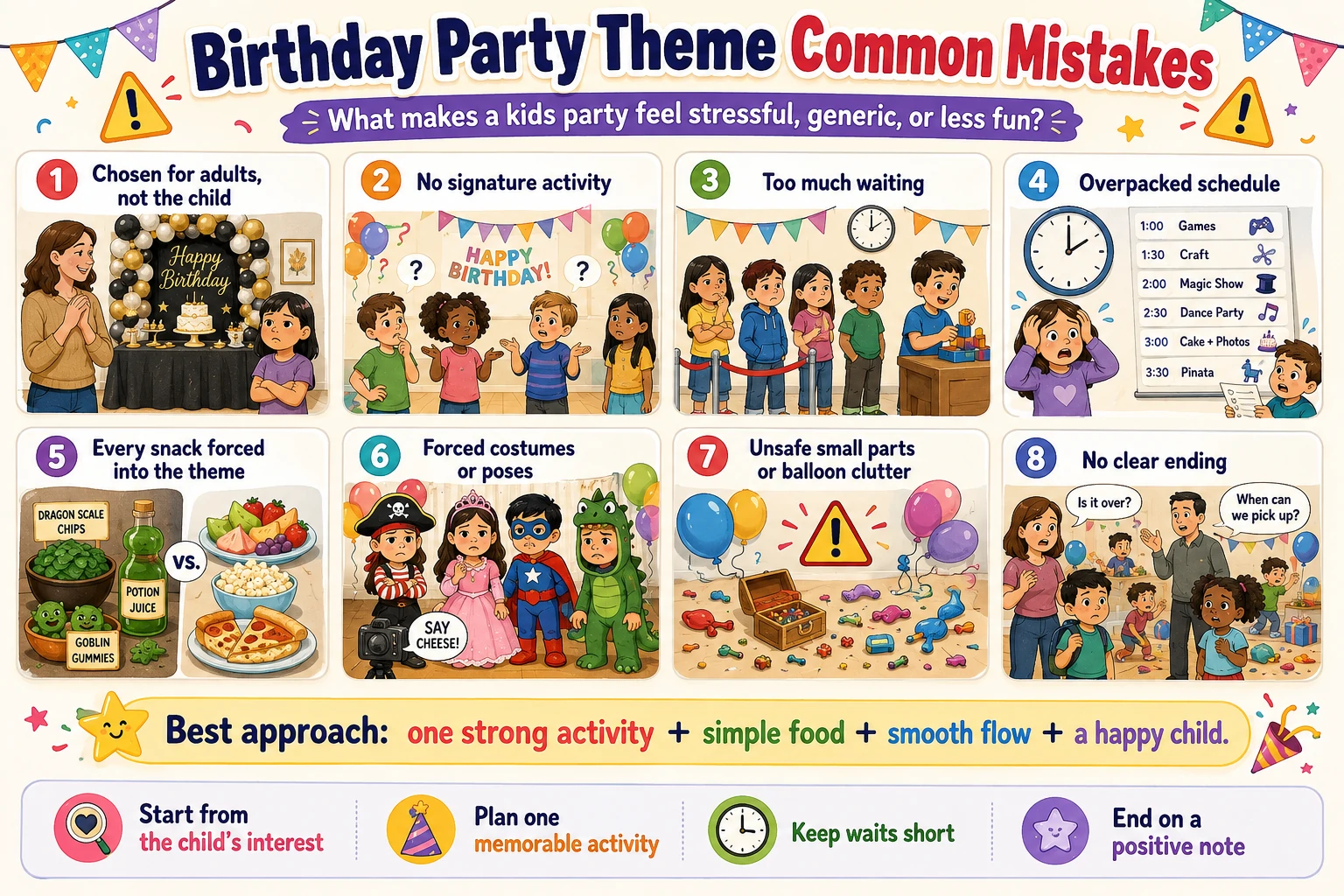
Common Kids Birthday Theme Mistakes
Kids Birthday Party Theme Final Checklist
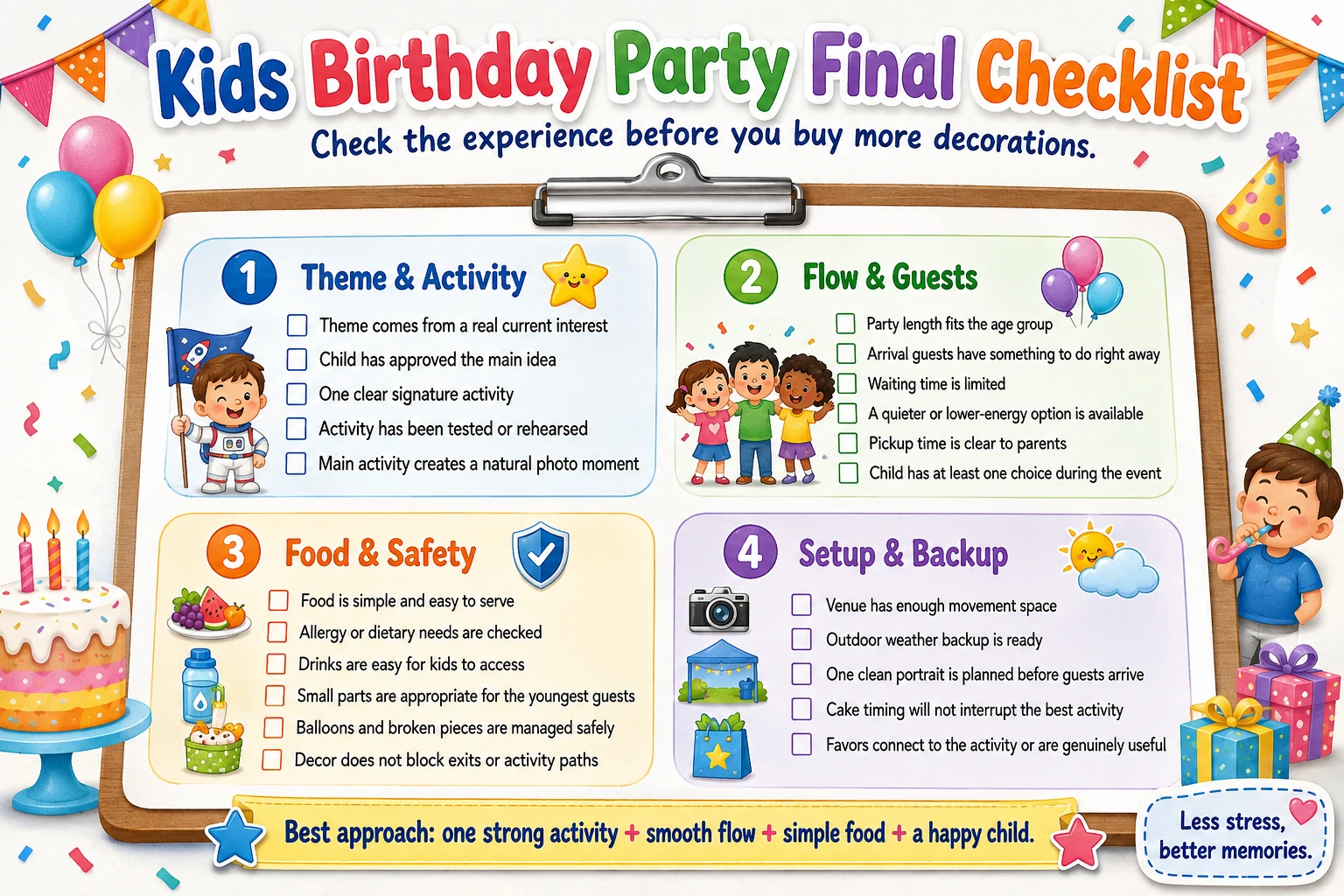
- The theme comes from a real current interest.
- The child has approved the central idea when age-appropriate.
- The party length fits the age group.
- There is one clear signature activity.
- The activity has been tested or rehearsed.
- Arrival guests have something to do immediately.
- Waiting time is limited.
- There is a quieter or lower-energy option.
- The venue has enough movement space.
- An outdoor weather backup exists.
- Food is simple enough to serve efficiently.
- Allergy or dietary information has been collected when needed.
- Drinks are easy for children to access.
- Small parts are appropriate for the youngest guests.
- Balloons and broken balloon pieces are managed safely.
- Decor does not block exits or activity paths.
- One clean portrait is planned before guests arrive.
- The main activity creates a natural photo moment.
- The cake moment will not interrupt the best activity.
- Pickup time is clear to parents or caregivers.
- Favors, if used, connect to the activity or are genuinely useful.
- The birthday child has at least one choice during the event.
Frequently Asked Questions About Birthday Party Themes for Kids
How Do I Choose a Birthday Theme When My Child Likes Many Things?
Choose the interest that creates the strongest party activity. If your child likes dinosaurs, art and football, ask which one they would most enjoy doing with friends for an hour. You can still use smaller references to other interests without turning the party into three themes at once.
What Are Good Birthday Party Themes for a 5-Year-Old?
Dinosaur explorer, art studio, space mission, animal rescue, builder challenge, storybook adventure and music-and-movement themes are strong choices because they support simple pretend play, making and movement without requiring long instructions.
What Are Better Party Themes for 8- to 10-Year-Olds?
At this age, increase challenge and ownership. Science labs, sports skills, baking, detective mysteries, gaming tournaments, art workshops, nature adventures and building challenges work well because children can follow multi-step activities and collaborate.
How Many Activities Should a Kids Birthday Party Have?
Fewer than many hosts expect. One signature activity, one secondary activity and free or flexible play are often enough. For younger children, short activity blocks are easier to manage than a packed sequence of games.
How Can I Make a Theme Look Good Without Spending a Lot?
Choose two or three colors, one strong visual anchor and one photo area. Let the activity materials provide much of the visual interest. Repeating a limited palette is usually more cohesive than buying many inexpensive themed decorations.
Should Every Party Favor Match the Theme?
No. A favor is strongest when it is useful or connected to what children made during the party. A painted canvas, decorated cookie, small science result, explorer badge or printed group photo can feel more relevant than a bag of unrelated plastic items.
The American Academy of Pediatrics’ HealthyChildren.org provides practical guidance on party length, short activity blocks and flexible play for young children. Read the birthday party guidance.
The U.S. Consumer Product Safety Commission provides guidance on choking-hazard labeling and small parts, including balloons and certain children’s products. Read the CPSC safety guidance.
The interest-first framework, five-layer party system, theme examples, activity-flow schedules and planning checklists in this article are original editorial guidance created for this guide.
Final Thoughts: Build the Party Around What the Child Loves to Do
A strong kids birthday theme does not need to dominate every object in the room. It needs to give the child and their friends a clear, enjoyable experience.
Start with a real interest. Turn that interest into one signature activity. Match the schedule to the age group. Use a limited visual identity to make the party feel cohesive. Then leave enough flexibility for children to play, talk, improvise and enjoy the part you could never have planned.
The final test: if you removed the themed plates, balloons and backdrop, would the child still recognize what the party is about from the activity itself? If yes, you have built a real theme—not just a decorated room.