
Birthday Photoshoot Ideas for Every Age and Style: A Practical Guide to Photos That Feel Personal
The best birthday photoshoot ideas do not begin with balloons, a backdrop or a trending pose. They begin with a person. A first birthday is about discovery. A teenager may want independence and identity. A 40th birthday can feel confident, reflective or adventurous. A 70th birthday may be most meaningful when the photographs show relationships, history and the life built around the guest of honor.
This guide will help you plan a birthday photoshoot that looks intentional and still feels true to the person being celebrated. It includes concepts for every age, a style-selection system, practical lighting guidance, age-appropriate posing prompts, an essential shot list, equipment starting points and a complete at-home session plan.
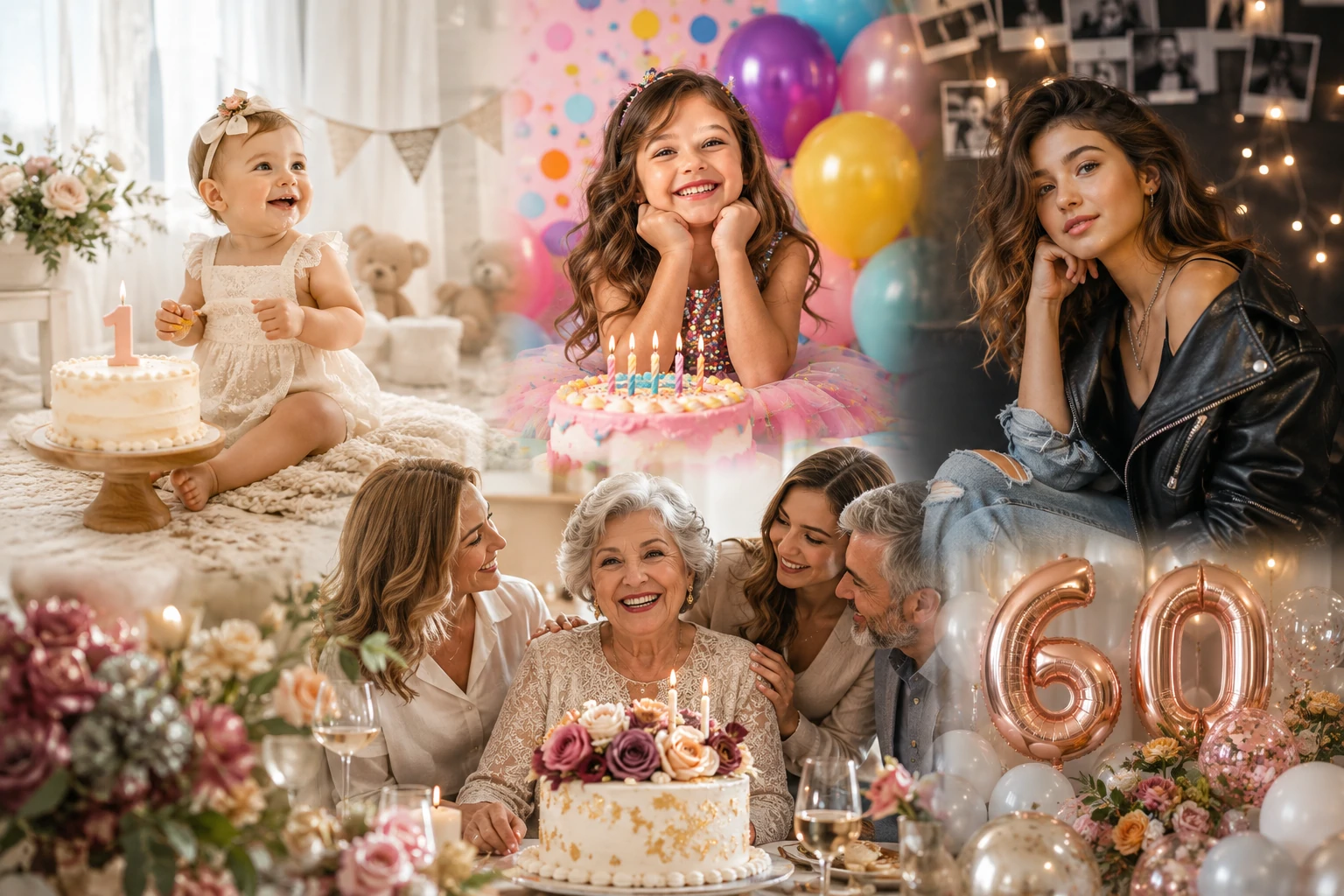
Decide three things before buying props: who the photos are for, where the finished images will be used and what emotion should remain when someone sees them years later. These choices determine the location, styling, pace, shot list and even whether the session should feel polished or documentary.
Plan the Birthday Story Before You Plan the Setup
A common mistake is treating a birthday shoot as a decoration project. The host selects a color palette, orders balloons and tries to place the birthday person in the middle. The result may look festive, but it often says very little about the person in the frame.
A stronger approach is to build the session around a simple birthday story. Ask what has changed in the past year, what the person currently loves and who matters most in this chapter of life. A child who has just learned to ride a bicycle may be better photographed outdoors with that bicycle than in front of a generic balloon wall. An adult celebrating a career change may prefer a confident editorial portrait. A grandparent may value a photograph with children and grandchildren more than a solo cake portrait.
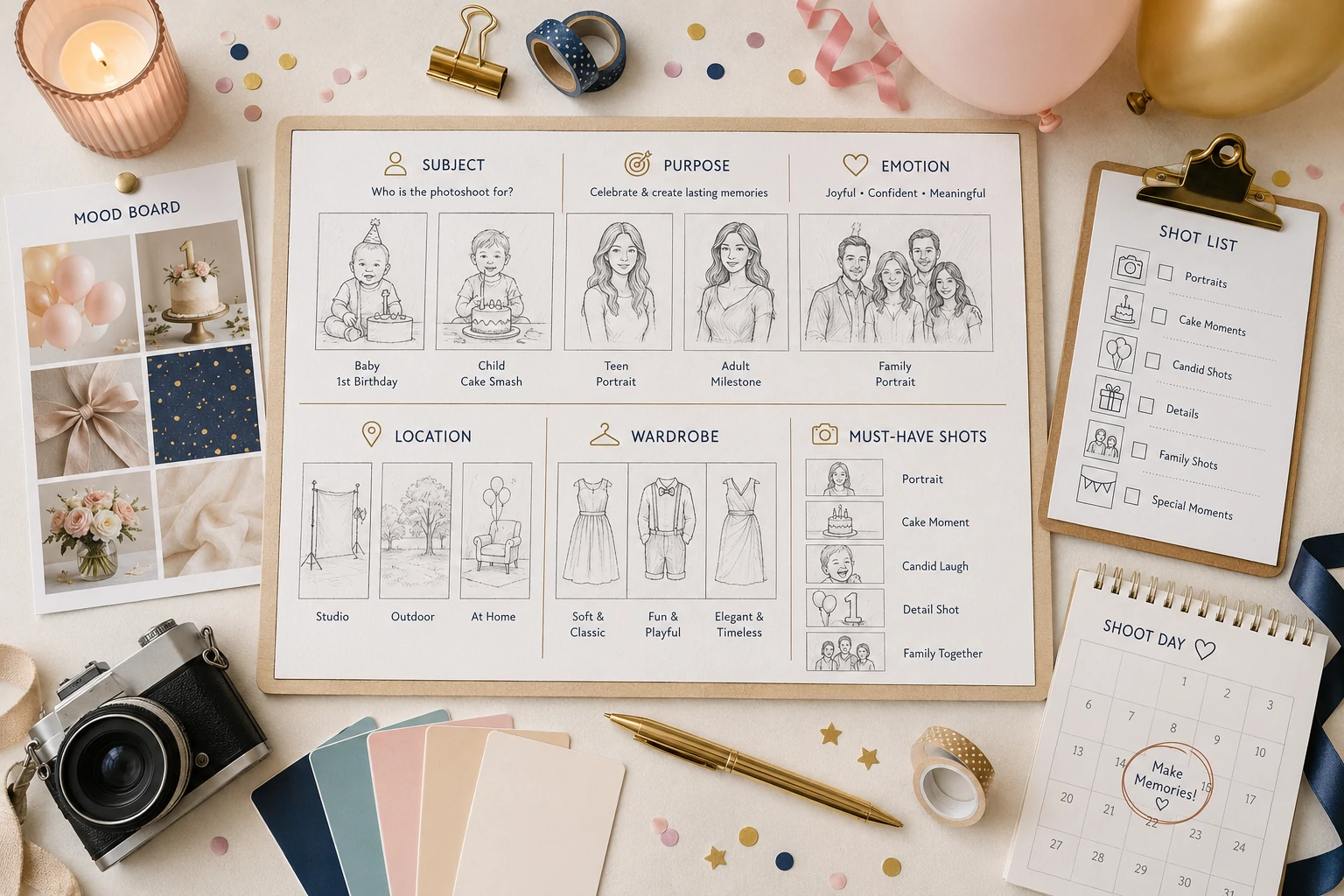
The Five-Frame Birthday Story
Even a short session should create more than one “hero” portrait. Use this five-frame structure to produce a small gallery with variety and narrative:
Birthday Photoshoot Ideas for Every Age
Age should influence the pace and purpose of a birthday photoshoot, but it should not limit its style. The goal is not to make every one-year-old look pastel or every 50-year-old look formal. Use age to anticipate attention span, mobility, self-consciousness and what the photographs may mean later.
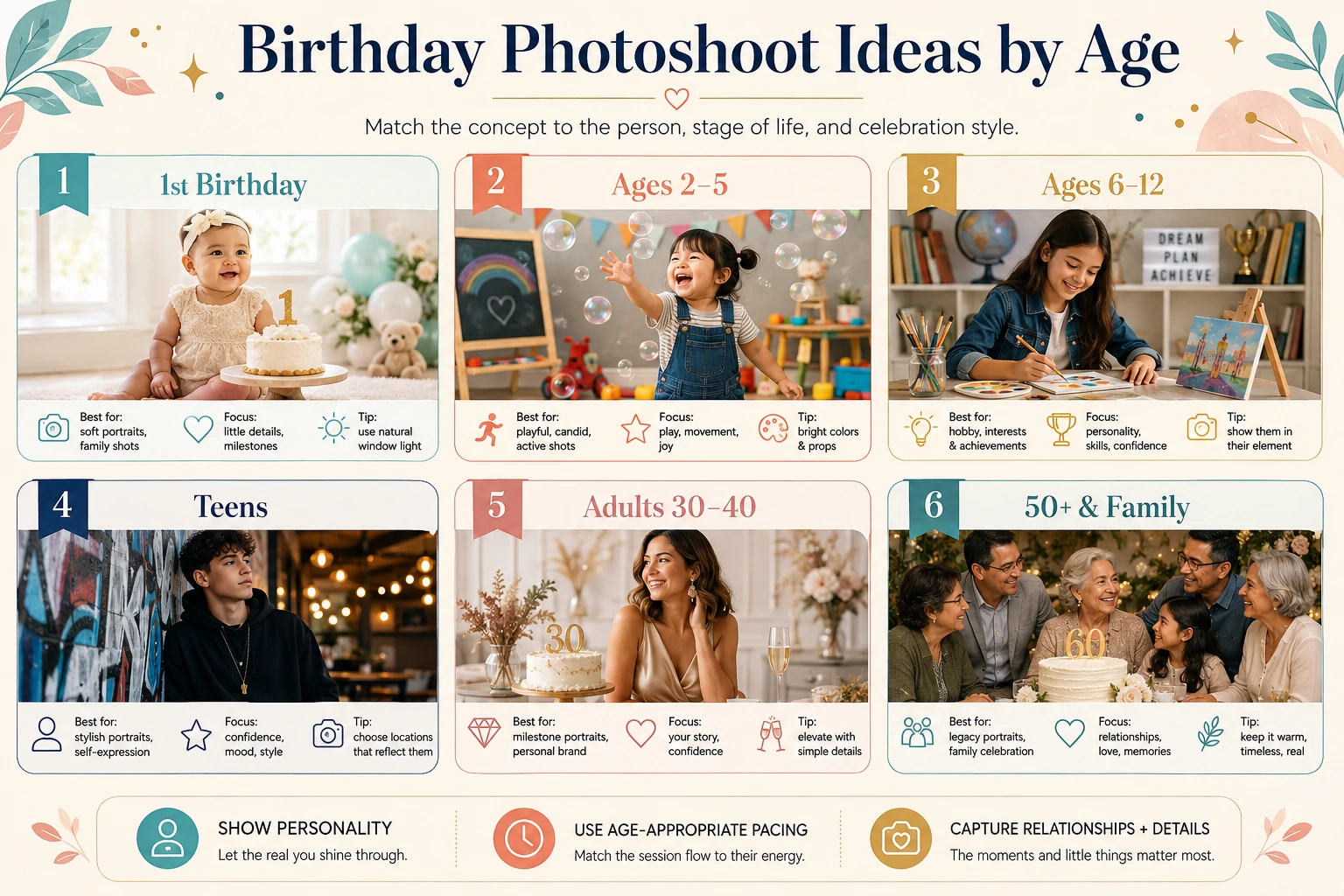
First Birthday: Discovery, Family and Small Details
A first birthday session works best when it follows the child’s attention rather than demanding a long sequence of poses. Begin with clean portraits while clothes, hair and the set are still tidy. Add parents or caregivers early, then introduce cake, toys or movement.
Useful concepts include a simple floor-level portrait by a large window, a favorite-toy setup, a family bed or sofa session, a seasonal outdoor picnic and a carefully supervised cake moment. Photograph small details such as hands, eyelashes, first shoes and the way the child interacts with caregivers.
Ages 2–5: Play First, Photograph Second
Preschool children rarely benefit from repeated instructions to sit still and smile. Build the shoot around an action: bubbles, chalk drawing, a tiny tea party, watering flowers, making pancakes, dancing or searching for hidden birthday stars. The activity provides natural hand placement and creates expressions more believable than a forced grin.
Keep one clean portrait area ready, but allow the child to move in and out of it. Photograph from the child’s eye level so the images feel connected rather than observational.
Ages 6–12: Interests, Achievements and Imagination
At this age, the birthday child can help shape the concept. Build the session around what they actually do: football, art, science experiments, books, dance, gaming, skating, baking or collecting. A “day in my world” theme often feels more personal than a party theme.
Include one polished birthday portrait, one action sequence and one image with the people who support the child’s interests. Let the child select a favorite image during the session; participation usually improves confidence and cooperation.
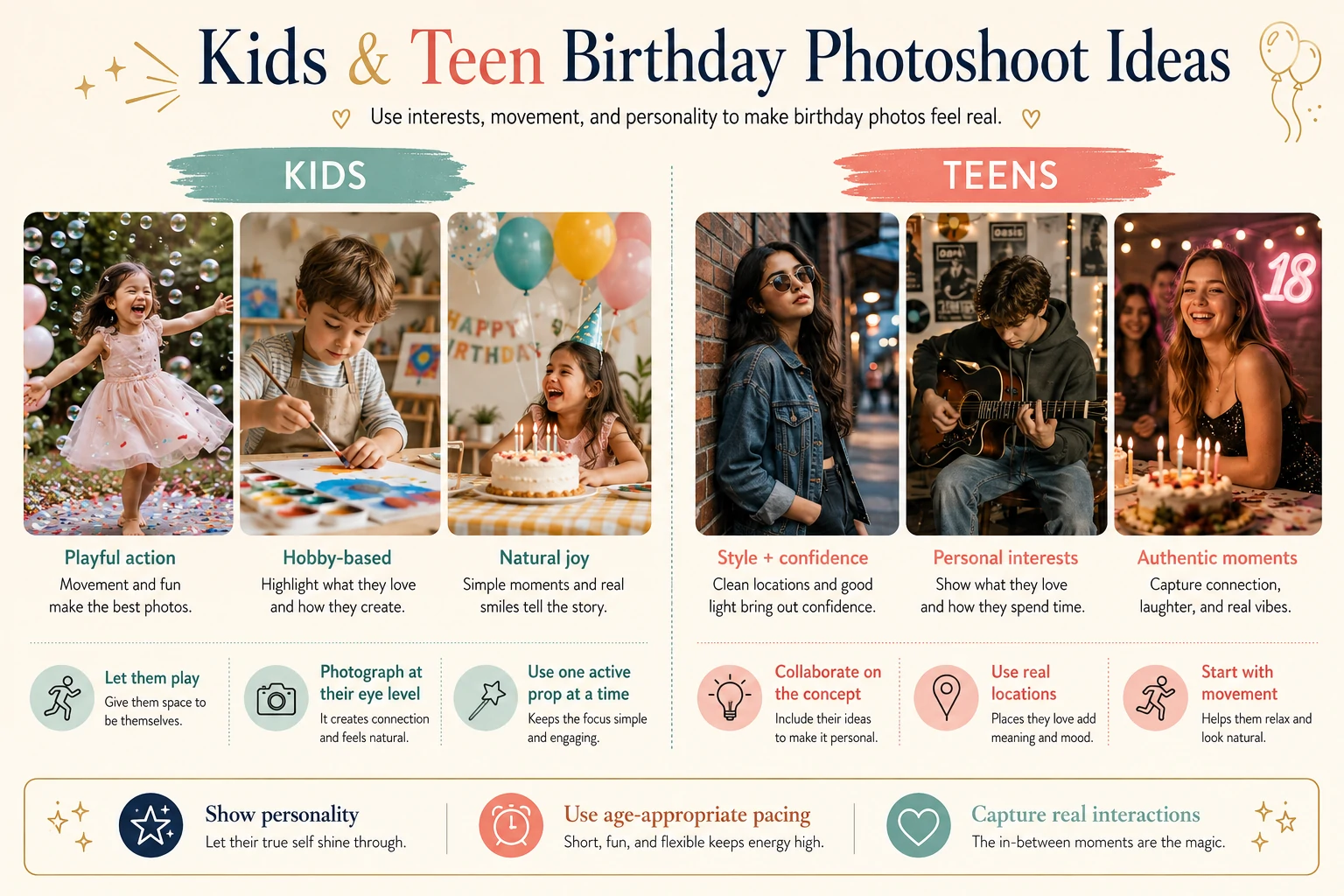
Teen Birthdays: Collaboration Instead of Performance
Teenagers often arrive with strong visual preferences and an equally strong fear of looking awkward. Show them the mood board, let them approve the location and avoid treating the session like a children’s party. Urban architecture, a record store, sports court, bedroom, café exterior, rooftop at sunset or a favorite neighborhood can feel more authentic than a decorated studio.
Start with movement to reduce self-consciousness: walk toward the camera, adjust a jacket, sit and stand, look over a shoulder, use headphones or interact with a friend. Review a few successful images early so the subject can see that the session is working.
18th and 21st Birthdays: Transition, Independence and Energy
These milestone birthdays can support two contrasting looks. Pair a polished “new chapter” portrait with a more energetic set involving friends, city lights, a dinner table, dancing or a hobby. The contrast creates a gallery that feels celebratory without reducing the person to a number balloon.
For a mature result, use the age as a secondary detail rather than the largest object in every frame. One number-based portrait is enough; use the remaining images to show personality and relationships.
30th and 40th Birthdays: Confidence, Context and Reinvention
A 30th or 40th birthday shoot can document who the person has become rather than imitate a conventional party. Consider an editorial portrait in a meaningful workspace, a relaxed session with close friends, a “then and now” recreation, an adventure-based session or a quiet home story with a partner and children.
Wardrobe should feel elevated but recognizable. A sharply tailored jacket, a favorite dress, clean denim, an heirloom accessory or a signature color can communicate more than a costume created for one afternoon.
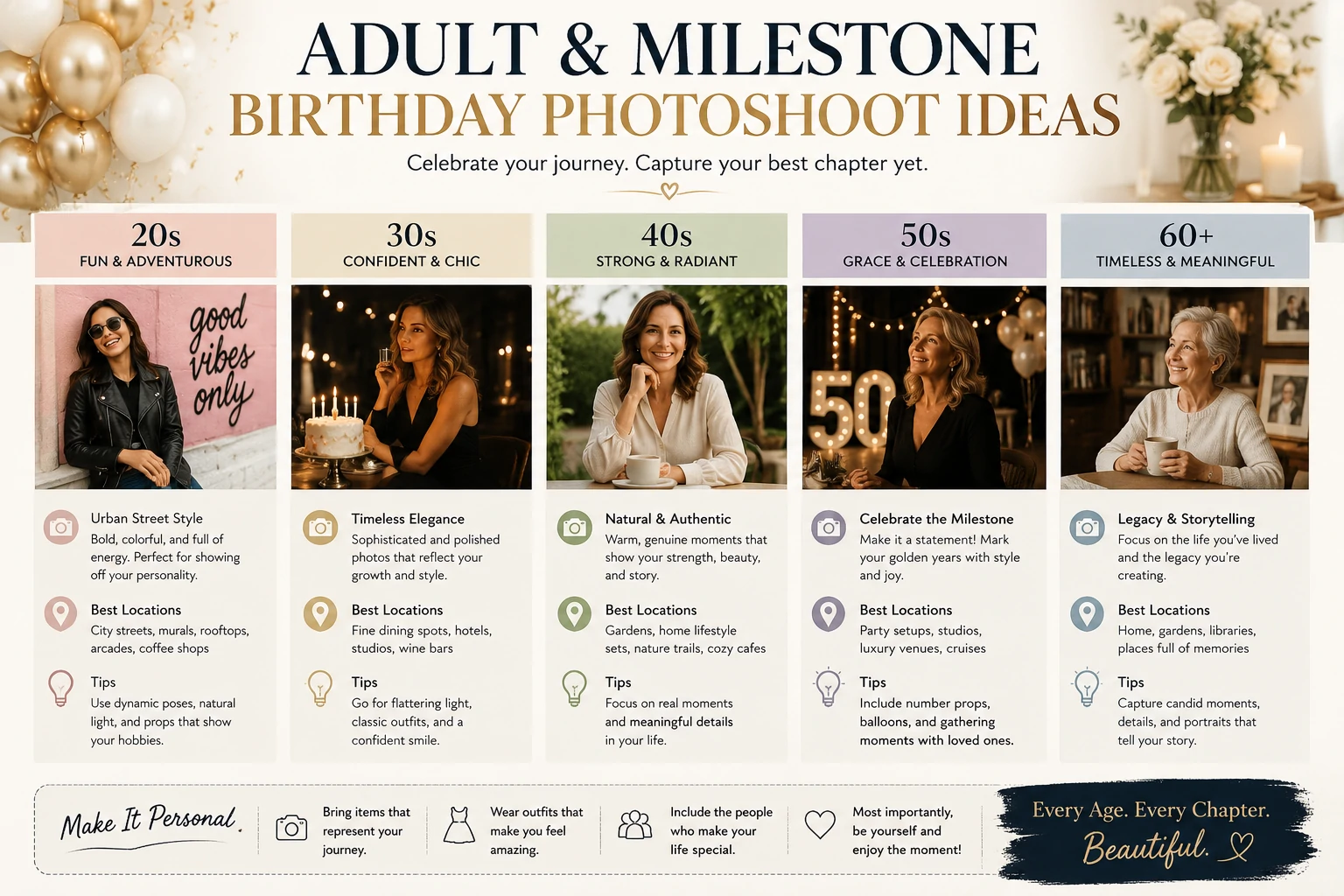
50th, 60th and Beyond: Presence, Legacy and the Life Around the Person
Older milestone sessions deserve creativity, not a smaller version of someone else’s shoot. Create an elegant portrait, but also photograph the guest of honor in a space with history: a garden they built, a kitchen where family recipes live, a workshop, a favorite chair, a community space or a landscape connected to their story.
Plan multigenerational photographs deliberately. Start with the largest group, then create smaller combinations: the birthday person with a partner, adult children, grandchildren, siblings and one-on-one portraits. Provide a chair, keep walking distances short and choose a location with easy access when needed.
A Birthday Photoshoot With Friends or Chosen Family
Group photos become more natural when people have something to do. Instead of lining everyone up for every image, photograph a toast, shared meal, walk, game, dance, conversation or recreation of an old group picture. Capture one formal image early, before the group becomes distracted, then move into candid coverage.
Choose a Birthday Photoshoot Style That Fits the Person
A cohesive style comes from repeating a few visual decisions: color, light, texture, wardrobe formality and the amount of movement. It does not require every prop to match perfectly.
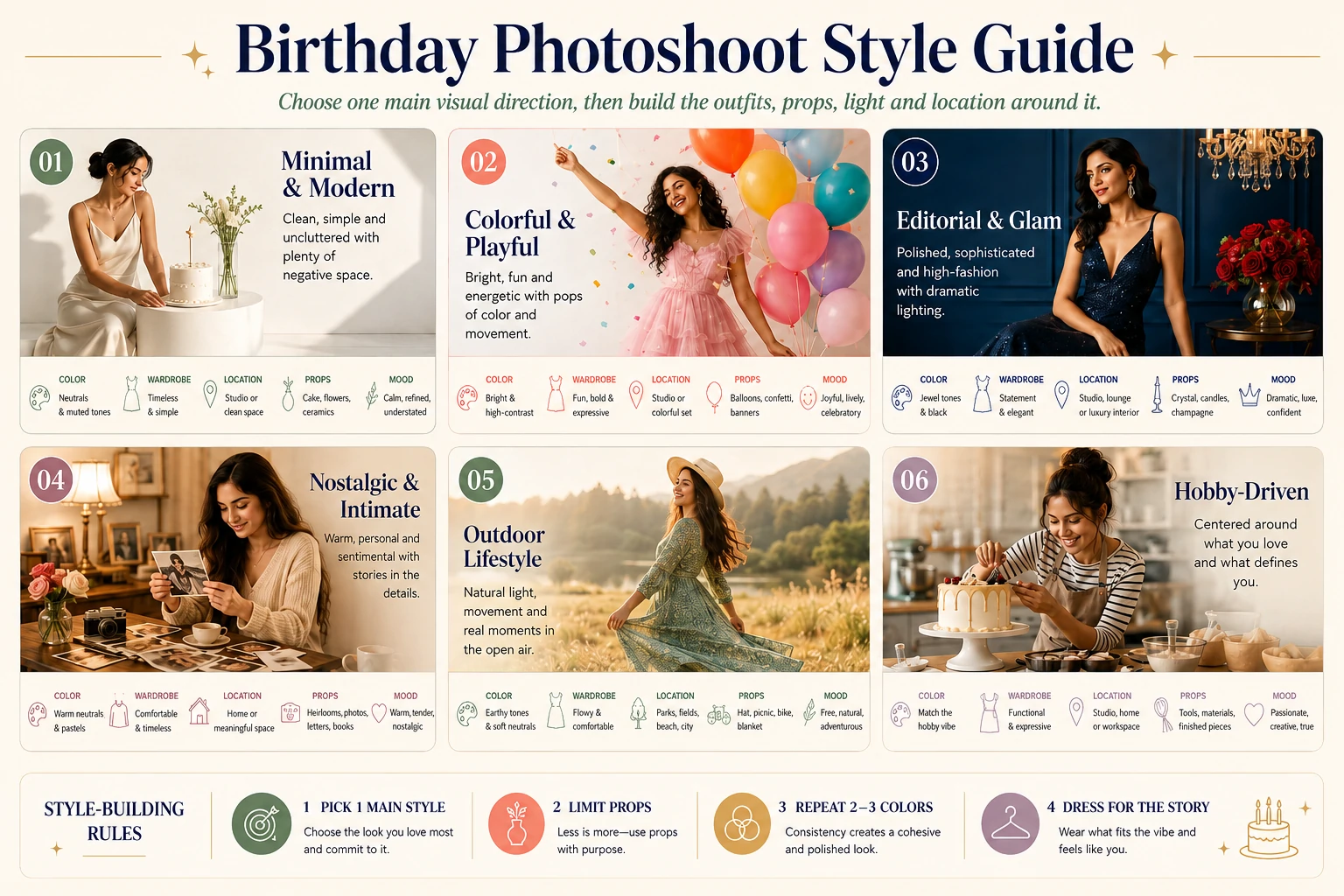
Wardrobe That Photographs Well
- Prioritize confidence and movement. The subject should be able to sit, walk, turn and raise their arms without constant adjustment.
- Use color intentionally. A solid color or controlled pattern is easier to coordinate with a backdrop than several competing prints.
- Create separation. Avoid wearing exactly the same tone as the background unless a monochrome look is planned carefully.
- Check fabric under light. Very reflective materials, thin white fabrics and tiny high-contrast patterns can behave differently on camera.
- Coordinate groups instead of matching them. Repeat two or three colors across the group without placing everyone in identical clothes.
Birthday Photo Lighting and Location: Make the Space Work Before Adding Decor
Lighting affects the result more than the price of the backdrop. Adobe’s portrait guidance emphasizes the value of understanding natural and artificial light, while Canon’s party-photography advice recommends staying ready for candid moments and changing event conditions. In practical terms, choose a space where the face can be lit cleanly and where the photographer has enough room to change distance and angle.
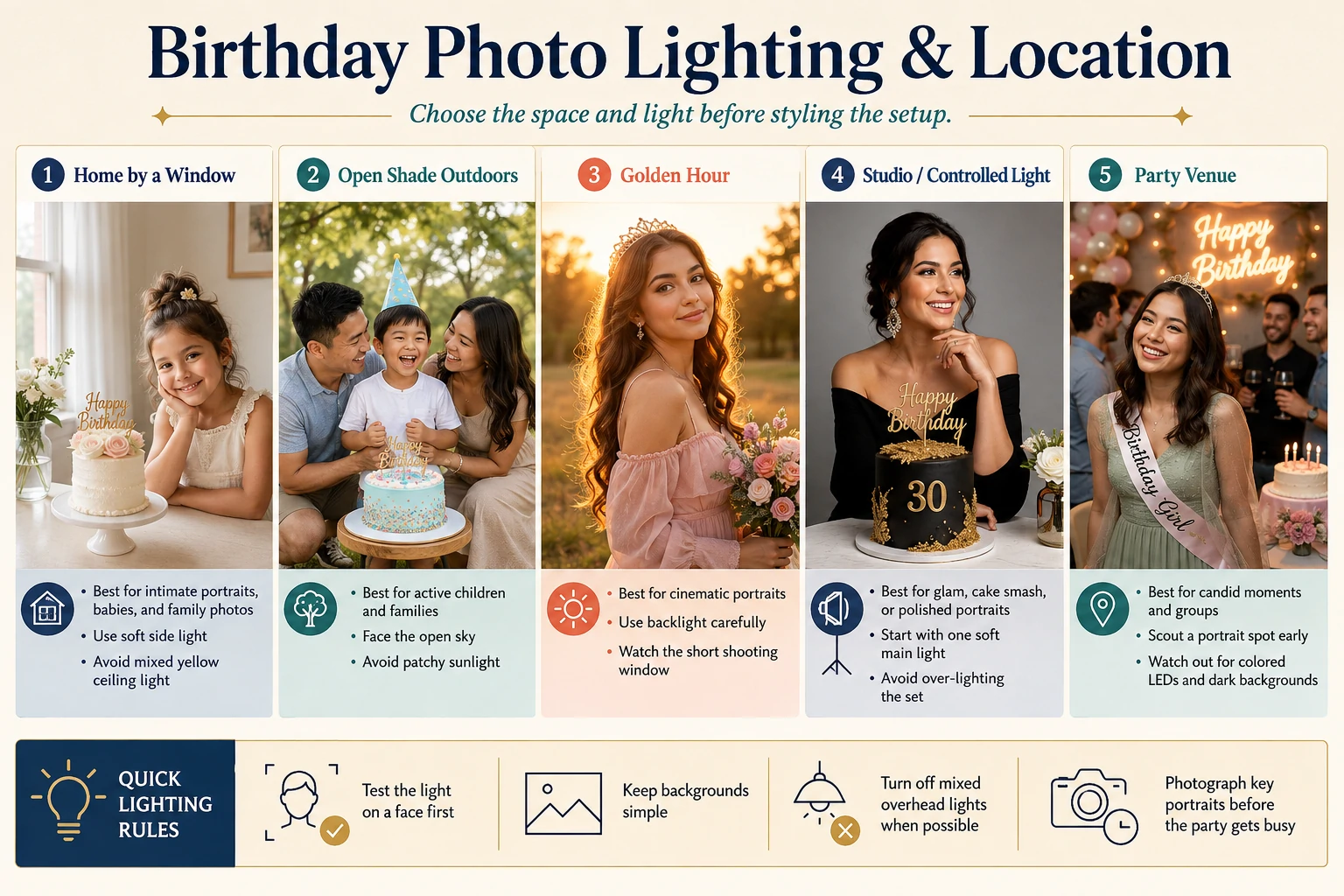
| Location | Best use | Lighting approach | Watch for |
|---|---|---|---|
| Home by a window | Babies, children, intimate adult portraits | Place the subject near the window and turn slightly until both eyes retain light | Mixed yellow ceiling light, clutter and bright exterior windows behind the subject |
| Open shade outdoors | Families, groups, active children | Use the bright edge of shade with the subject facing the open sky | Patchy sunlight from trees and green color reflected from grass |
| Golden hour | Teens, couples, cinematic milestones | Backlight for atmosphere, then expose carefully for the face | A very short shooting window and rapidly changing brightness |
| Studio or controlled room | Editorial, glam, cake smash, consistent galleries | Use one large soft light first; add complexity only when needed | Over-lighting the set until the image looks flat |
| Party venue | Documentary coverage and groups | Scout before guests arrive; identify one dependable portrait corner | Colored LEDs, dark ceilings, restricted movement and crowded backgrounds |
A Simple Window-Light Setup
- Turn off nearby ceiling lights to reduce mixed color.
- Place the subject about one to two steps from the window rather than pressing them against it.
- Angle the body away from the window and turn the face back toward the light.
- Use a white wall, curtain or foam board opposite the window if shadows become too deep.
- Move the background farther behind the subject to create separation and reduce distracting detail.
Birthday Photoshoot Poses That Do Not Look Forced
“Smile” is not a complete posing direction. Good prompts give the body a task, direct attention and create a reason for the expression. Begin with simple posture, then add an action.
Practical Phone and Camera Settings
The following are starting points, not fixed rules. Adjust for the actual light, the speed of the subject and the camera’s capabilities.
For additional technical grounding, Adobe’s portrait photography guide explains lighting, focus and subject connection, while Canon’s party photography guide covers candid images, motion and challenging event light.
The Essential Birthday Photoshoot Shot List
A shot list protects the photographs that matter when the session becomes busy. It should guide the photographer without preventing spontaneous moments.
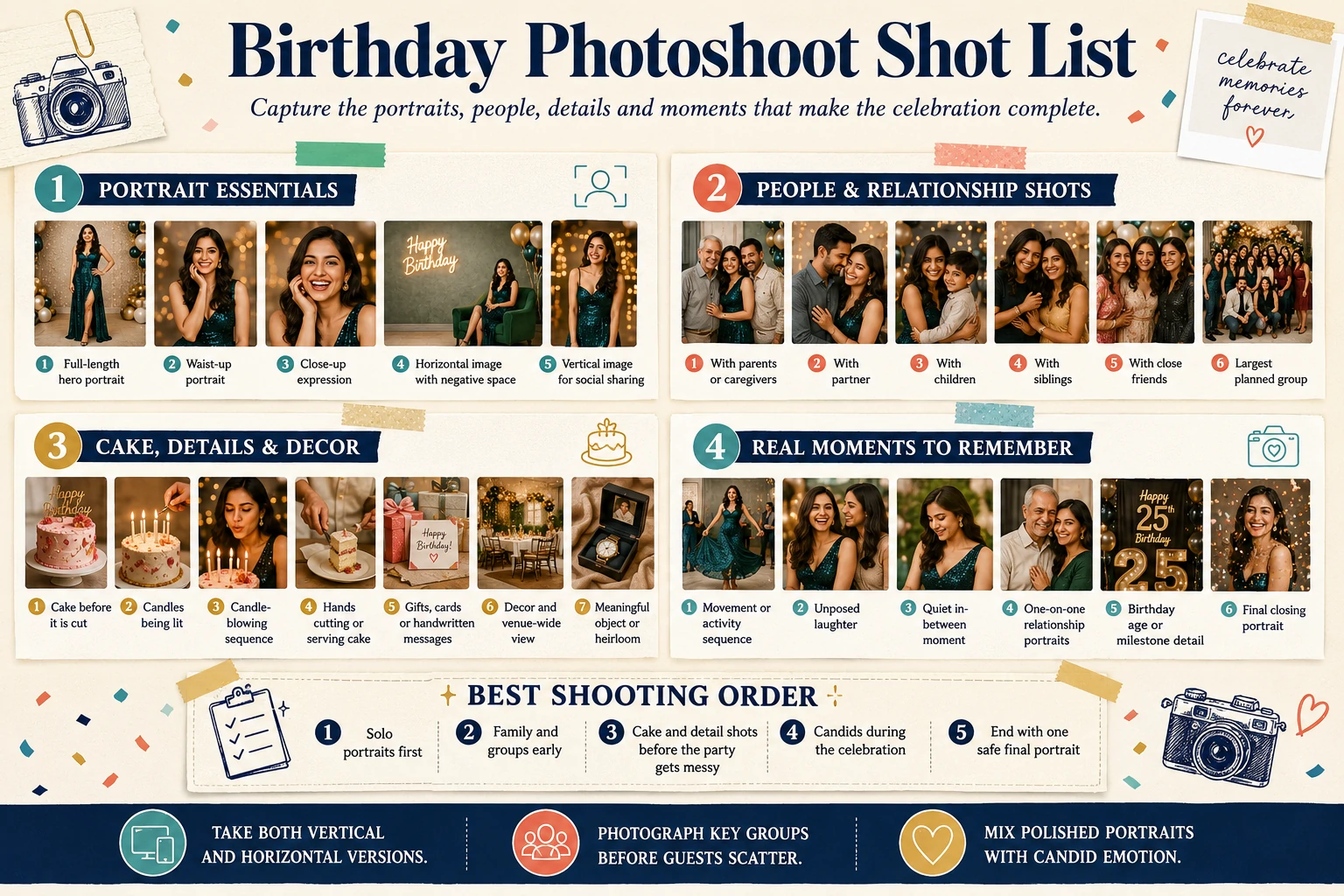
- Full-length hero portrait
- Waist-up portrait
- Close-up expression
- Horizontal image with negative space
- Vertical image for social sharing
- Birthday age or milestone detail
- Birthday person with parents or caregivers
- Birthday person with partner
- Birthday person with children
- Birthday person with siblings
- Birthday person with close friends
- Largest planned group
- One-on-one relationship portraits
- Cake before it is cut
- Candles being lit
- Candle-blowing sequence
- Hands cutting or serving cake
- Gifts, cards or handwritten messages
- Decor and venue-wide view
- Movement or activity sequence
- Unposed laughter
- Quiet in-between moment
- Meaningful object or heirloom
- Final closing portrait
Use Your Best Birthday Photos in a Finished Frame or Collage
A birthday photoshoot becomes more useful when the final images have a clear destination. After selecting the strongest portrait, relationship frame and milestone detail, place them into a coordinated birthday design for a digital greeting, party recap, printable keepsake or social post.
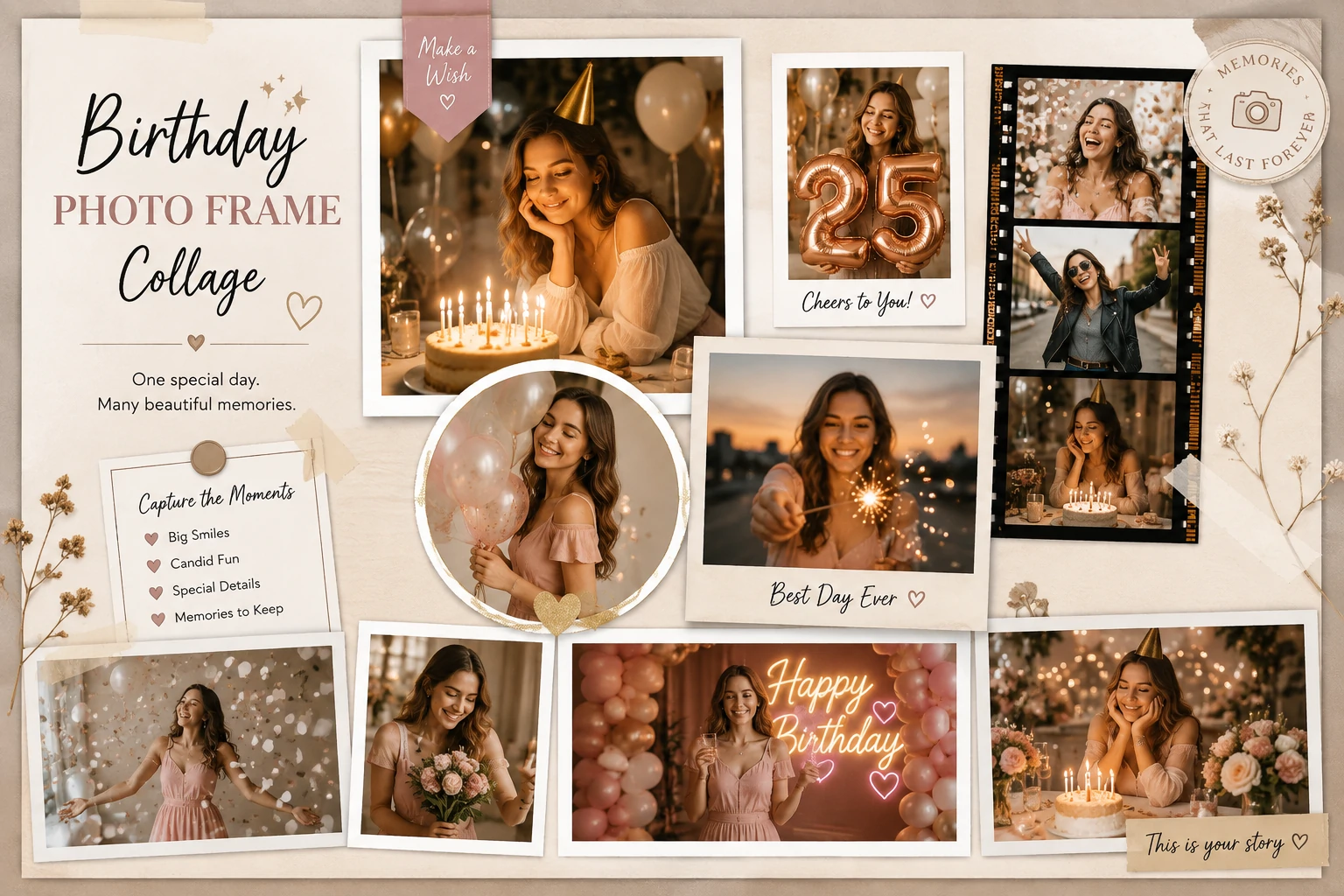
The birthday template collection on MRRFrame lets you upload photographs, adjust their placement and add a birthday message without rebuilding the entire layout from scratch.
A strong three-image combination: one clear hero portrait, one photograph with important people and one candid or detail image that establishes the celebration.
Explore Birthday Photo TemplatesA 30-Minute At-Home Birthday Photoshoot Plan
An effective home session does not need to occupy the entire day. Prepare the light, background, wardrobe and cake before the birthday person enters the set.
| Time | What to photograph | Why this order works |
|---|---|---|
| Minutes 0–5 | Clean solo portraits: full length, waist-up and close-up | Energy, clothing and the setup are at their freshest |
| Minutes 5–10 | Movement prompts and personality images | Reduces stiffness before attention begins to drop |
| Minutes 10–15 | Parents, partner, siblings or close family | Secures relationship photographs while everyone is ready |
| Minutes 15–20 | Cake, age detail, gifts or meaningful objects | Adds the birthday context without dominating every portrait |
| Minutes 20–25 | Candles, celebration and candid interaction | Creates the emotional peak of the gallery |
| Minutes 25–30 | One creative experiment and one safe closing portrait | Allows variety while ensuring the session ends with a usable image |
Three Budget Levels That Can All Look Intentional
The difference between these levels should be production complexity—not whether the photographs feel personal. A meaningful location and good interaction can outperform an expensive set with no connection to the birthday person.
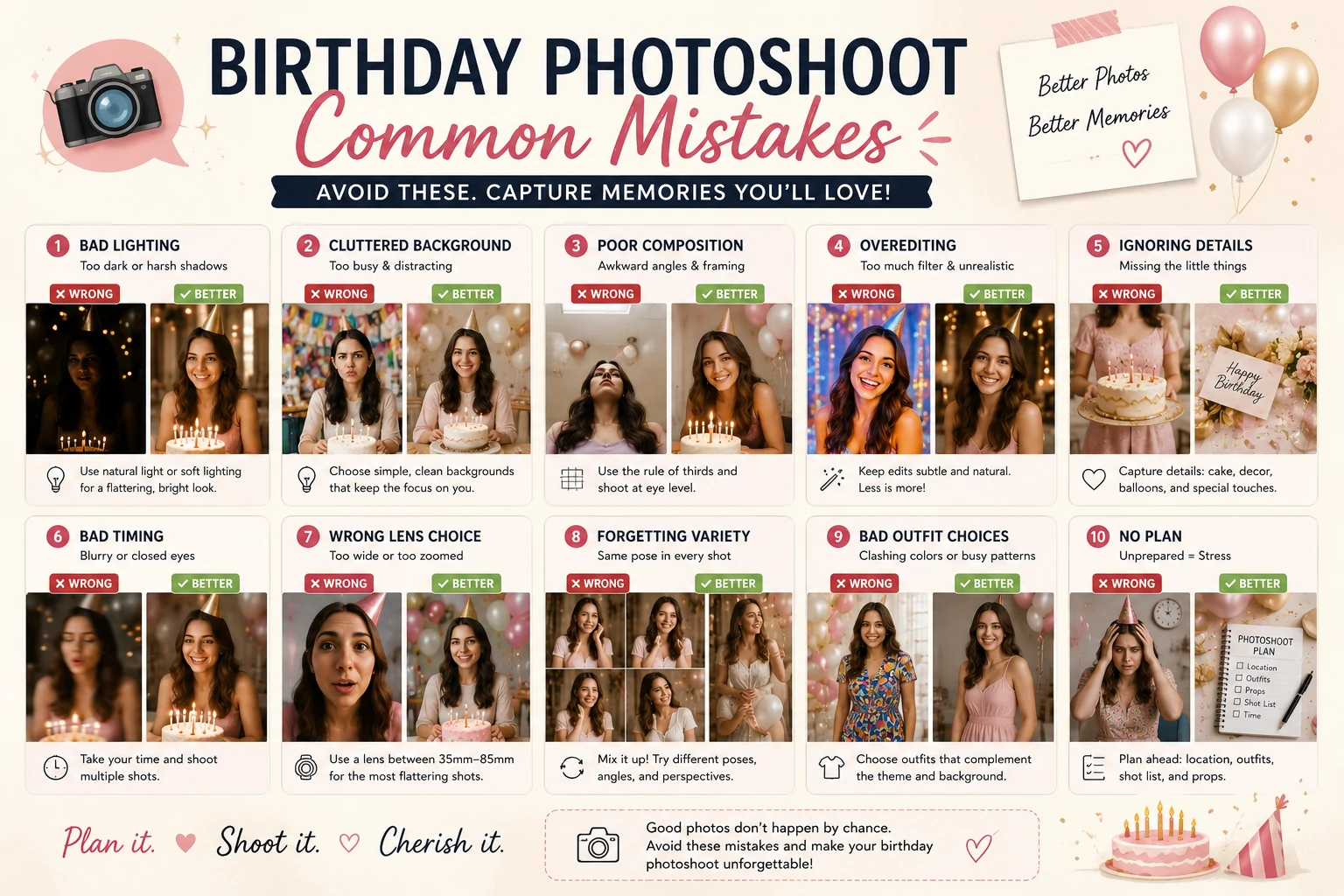
Birthday Photoshoot Mistakes That Make Good Ideas Look Generic
Birthday Photoshoot Final Checklist
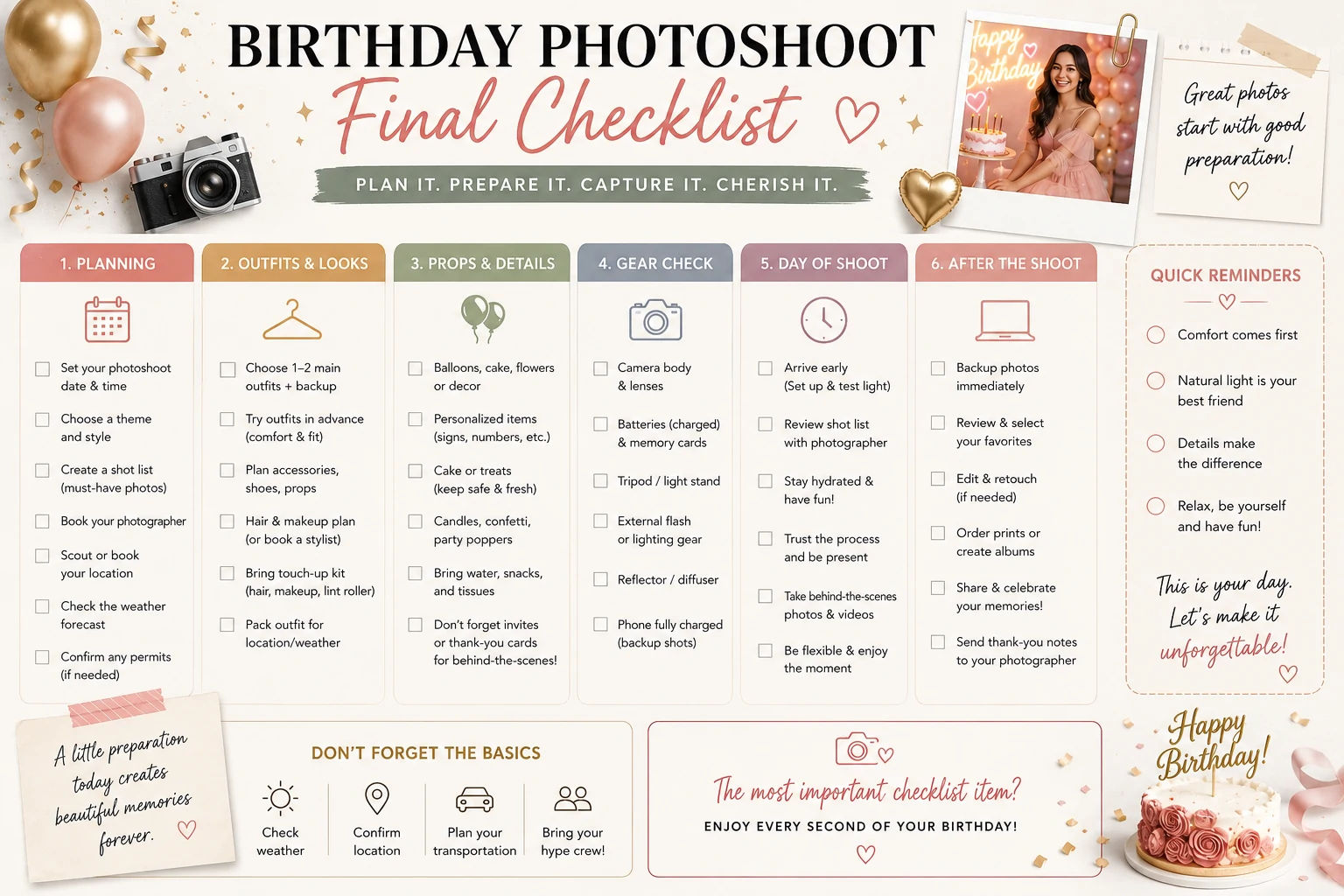
- The concept reflects the birthday person.
- The final use of the photographs is clear.
- The location has suitable light and access.
- A weather or indoor backup exists.
- The hero outfit has been tested for movement.
- Group colors coordinate without becoming identical.
- Props are safe, relevant and limited.
- The cake and candles are ready at the planned time.
- Important family combinations are listed.
- The largest group photo is scheduled early.
- Phone and camera batteries are charged.
- Storage cards or phone space are available.
- The lens and phone camera are clean.
- Permissions for photographing and sharing are understood.
- Children’s food, supervision and comfort needs are confirmed.
- Older guests have seating and easy access when needed.
- The photographer knows the must-have images.
- A plan exists for backing up the final photographs.
Frequently Asked Questions About Birthday Photoshoot Ideas
What Is the Best Color to Wear for a Birthday Photoshoot?
There is no universal best color. Choose a color that suits the person, separates from the background and supports the intended mood. Jewel tones can feel rich, pale neutrals can feel soft and a strong signature color can make a simple set memorable. Test the complete outfit in the actual light before the session.
Can I Do a Birthday Photoshoot With Only a Phone?
Yes. Use the rear camera when practical, clean the lens, find soft directional light and avoid digital zoom. Tap the nearest eye to focus, use burst or Live Photos for movement and take both vertical and horizontal versions of important frames.
What Props Do I Need for a Simple Birthday Photoshoot?
One cake or cupcake, one age detail and one personal object are enough. A chair, flowers, a favorite book, an instrument or a printed childhood photograph can add meaning without making the frame crowded.
How Long Should a Birthday Photoshoot Last?
Small children may work best in short 15–30 minute blocks. A focused adult portrait session can often be completed in 30–60 minutes, while multiple outfits, locations or large family combinations require more time. Session length should follow attention, mobility and the number of must-have images.
Should the Photoshoot Happen Before or During the Birthday Party?
For polished portraits, photograph before the party or before guests arrive. During the event, focus on candid interaction, groups, cake and atmosphere. Combining a short pre-party portrait session with documentary coverage usually creates the most complete gallery.
How Can I Make Birthday Photos Look Less Posed?
Give the subject an action instead of asking for a smile. Walking, adjusting clothing, lighting candles, telling a story, interacting with another person or doing a favorite activity creates natural body language and expressions.
Adobe provides practical portrait guidance on lighting, focus and creating a connection with the subject. Read Adobe’s portrait photography guide.
Canon’s party-photography guide covers candid moments, background separation and working in changing event light. Read Canon’s party photography tips.
The age-specific concepts, planning framework, five-frame story, shot list and at-home schedule in this article are original editorial guidance created for this birthday photoshoot guide.
Final Thoughts: Photograph the Person, Not Just the Birthday Theme
A birthday photoshoot succeeds when the images could belong only to the person being celebrated. Decorations establish the occasion, but identity, relationships, movement and small details create the memory.
Begin with the story, secure the essential portraits early and leave enough room for real interaction. The final gallery should show not only how the birthday looked, but who the person was at that exact age—and why that chapter was worth remembering.
Editorial note: Adapt every setup to the subject’s comfort, mobility, supervision needs, location rules and permission preferences. No photograph is more important than a safe and respectful experience.